

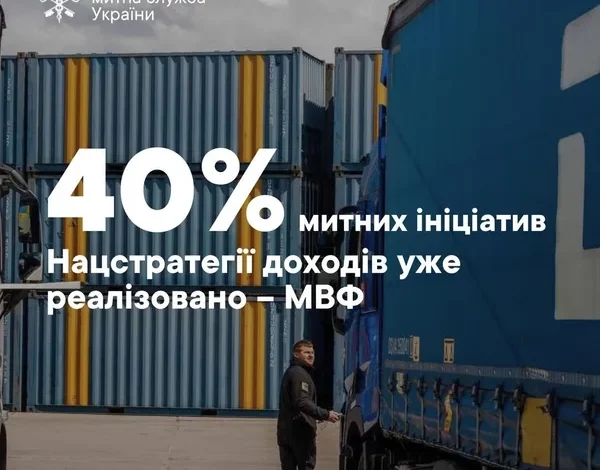
The Fiscal Affairs Department of the International Monetary Fund has assessed that Ukraine’s customs authorities have already implemented around 40% of the customs initiatives envisaged by the National Revenue Strategy to 2030. Of the 152 planned measures, almost half have already been carried out, primarily through the development and adoption of key regulatory and legal acts for customs reform.
One of the main areas highlighted is the harmonisation of legislation with European Union law. Ukraine has already adopted a law that aligns certain provisions of the Customs Code with European standards. A draft of the new Customs Code of Ukraine has been prepared to ensure full compliance of customs legislation with EU rules; the document has been approved by the Government and registered in the Verkhovna Rada.
Digital solutions for customs are being actively developed. The updated Strategic Plan for the Digital Development of the State Customs Service has been drawn up on the basis of the EU’s multi-annual strategic plan for electronic customs (MASP-C) and taking into account the list of electronic systems provided by the Directorate-General for Taxation and Customs Union of the European Commission (DG TAXUD). This is intended to ensure the implementation of EU customs legislation in Ukraine.
As part of anti-corruption changes, the law on service in customs authorities has entered into force, introducing professional certification, integrity checks using polygraphs, staff rotation and other transparency measures. A pilot project on the use of body cameras by customs officers has shown high effectiveness and is gradually being extended to new sections of the border.
The technical upgrading of crossing points is continuing. Scanning systems and weighing stations are being installed at the border, with priority given to mobile scanners in view of Ukraine’s focus on a shared border with the EU. At the same time, preparations are under way to launch fixed scanning systems for inspecting trains and containers, the first of which are to become operational by the end of the year. The Government has also provided for the introduction of a multi-level full video surveillance system that will combine fixed and body-worn video cameras.
Despite wartime conditions, the number of declarations processed under the common transit procedure within the framework of the so-called “customs visa-free regime” is increasing. In the first five months of 2026, almost 83 thousand transit declarations were processed, almost double the figure for the same period of the previous year.
The Authorised Economic Operator (AEO) programme, which is important for the European integration course, is also developing. At present, 127 Ukrainian companies hold AEO-C status, seven of which have additionally received AEO-B authorisation. The number of programme participants is constantly growing, bringing Ukraine closer to mutual recognition of AEO status with other countries.
The State Customs Service notes that this list of customs reform achievements is not exhaustive; however, more than half of the measures envisaged by the National Revenue Strategy still require practical implementation and resources. Progress on the reform can be monitored on the official web portal of the State Customs Service, in the “Service Reform” section, where updated data on the implementation of the planned steps will be published quarterly.