

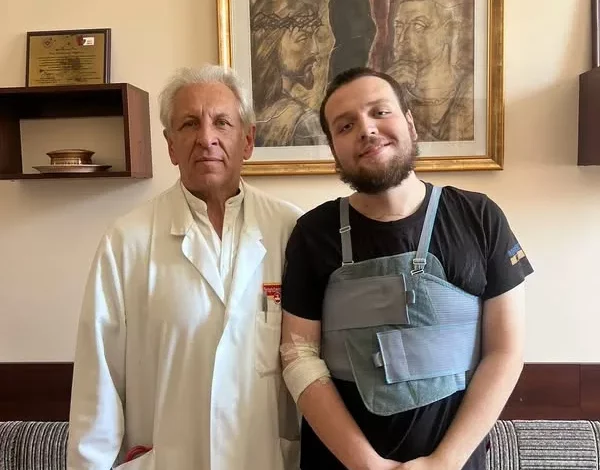
At the Danylo Halytsky LNMU University Hospital in Lviv, surgeons have performed an extremely complex operation on a 23-year-old US citizen serving in the Armed Forces of Ukraine. The soldier, named Andrew and originally from Philadelphia, deliberately chose to be treated by Ukrainian cardiac surgeons, even though he could have undergone surgery in the United States.
Before the full-scale invasion, Andrew worked as a nurse in America. Last year he voluntarily came to Ukraine and joined the ranks of the Armed Forces, became a drone operator and went to the front line, where he received the call sign “Hollywood”. At the same time, back in 2022 in the United States, he had already suffered his first pulmonary artery thromboembolism, and while serving at the front his condition deteriorated: he developed shortness of breath, a cough and sputum streaked with blood.
After examinations first in Kyiv and later in Lviv at the University Hospital, the serviceman was diagnosed with a rare and very complex condition — chronic thromboembolic pulmonary hypertension. According to the doctors, with this pathology, clots from the veins of the lower limbs can travel to the pulmonary arteries, fail to dissolve completely, accumulate and block the vessels, causing dangerously high pressure in the lungs and threatening severe disability or even death without treatment.
The University Hospital is a reference centre for the treatment of such patients — both conservatively and surgically — and patients are therefore referred to Lviv from different regions. The doctors suggested that Andrew consider having surgery at a leading centre in California, but he stressed that he trusted Ukrainian specialists in particular and wanted to be treated here. The serviceman passed the military medical commission and is registered in the eHealth and NHSU systems, so his treatment in Ukraine is free of charge.
The cardiac surgeons performed one of the most technically demanding procedures in cardiac surgery, which lasts about seven hours and requires a complete cessation of blood circulation for certain periods of time. During the intervention, the patient is cooled to 16 °C so that the surgeons can reach clots in the most distant sections of the pulmonary arteries, after which the body temperature is gradually brought back to normal.
“We completely cool the patient down to 16 °C, and during the operation we have to stop blood circulation entirely for certain intervals (15 minutes) so that the surgeons can reach the clots in the most distant sections of the pulmonary arteries. After 15 minutes we restore the circulation again. In this patient, the total time of complete circulatory arrest was 75 minutes. After that, the body is gradually warmed up; this stage alone can last around an hour and a half. That is why this operation is lengthy and risky. But we have been performing such operations for a long time now — we have been operating on such patients for 40 years,” said cardiac surgeon Professor Liubomyr Kulyk
The postoperative period required constant monitoring by anaesthetists and cardiologists to prevent possible complications, which are common with such interventions. According to cardiologist Marta Voitsekhovska, Andrew had no complications, the wound healed well, and as early as the second day after surgery he was already up and walking.
The serviceman has now been discharged from hospital. After a few months of rehabilitation, he plans to return to his unit in Zaporizhzhia and continue fighting as part of the Armed Forces of Ukraine.