

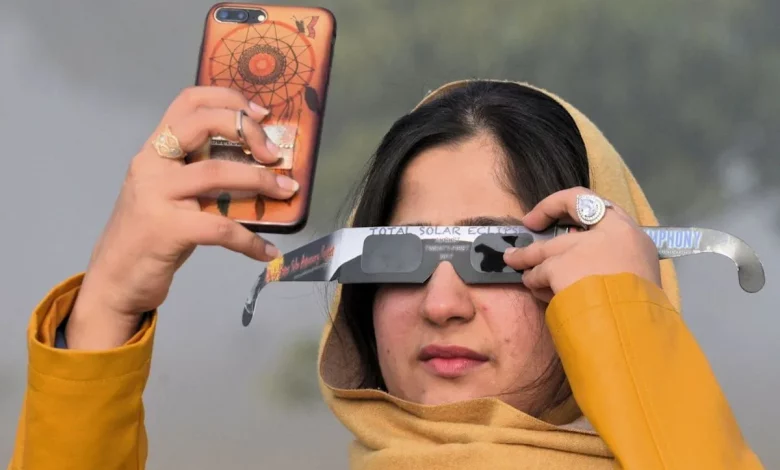
On Wednesday, hundreds of millions of people in Europe will be able to see a partial or total solar eclipse as the Moon passes in front of the Sun. Many are planning to capture the celestial event on a phone or digital camera, but specialists are warning that pointing your device directly at the Sun could permanently damage it.
Experts explain that aiming the lens straight at the Sun, even during a partial eclipse, creates a risk of overheating your smartphone or camera. Keeping the camera trained on the Sun for an extended period can cause the photodiodes in the sensor to burn out, leading to ‘dead’ pixels appearing in your shots that cannot be restored.
NASA notes that a phone’s sensor can be damaged just like any other imaging sensor if it is pointed directly at the Sun. Specialists advise that when photographing the eclipse (at all times except during the total phase), you should hold special eclipse-viewing glasses or another certified solar filter in front of the smartphone or camera lens.
NASA also stresses the danger to your eyesight. You must not look at the Sun through a camera lens, telescope, binoculars or any other optical instrument, even if you are wearing eclipse glasses or using a handheld solar filter. Radiation concentrated through the optics can burn through the filter and cause serious eye damage.
If you are watching a partial or annular eclipse through a telescope or binoculars with a correctly fitted solar filter, additional eclipse glasses are not necessary: the filter on the optical instrument itself provides the protection. The only time it is acceptable to look at an eclipse with the naked eye without any protective equipment is during the brief phase of total darkness, when the Moon completely covers the Sun.
During this eclipse, the total phase will be visible to people directly on the path of the totality band, including in certain regions of Iceland and Spain. For them, the total phase will last for roughly one to three minutes. This is the first total eclipse over Spain in more than a hundred years, and for the United Kingdom it will be the most complete of this century.