

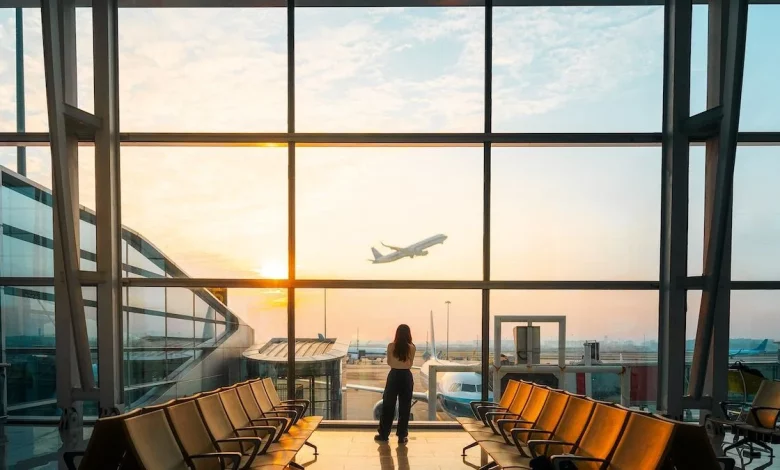
Fear of flying, or aerophobia, prevents millions of people from travelling by air, even though flying remains statistically the safest form of transport. Since the Covid-19 pandemic, passenger anxiety has increased, but at the same time more programmes and digital services have appeared to help people cope with this fear.
It is estimated that around 10% of people in the UK have a pronounced fear of flying. A survey by Confused.com of 2,000 Britons with this anxiety found that 30% of respondents prefer to holiday within the country so as not to board a plane. Some of those who do still travel abroad choose to go by car, train or ferry, despite data from the US Bureau of Transportation Statistics for 2010–2019 showing that commercial aviation has just 0.002 fatalities per billion passenger-miles, compared with 0.31 for trains, 3.5 for cars and 212 for motorbikes.
The International Air Transport Association (IATA) estimates that avoiding air travel costs airlines and the tourism industry around US$2.5 billion a year in lost revenue. To change this, European carriers are developing dedicated programmes for anxious passengers. Since 2012, EasyJet’s Fearless Flyer course has helped more than 14,000 people. The programme consists of 16 online modules lasting from 4 to 20 minutes, which explain the sounds and movements of the aircraft and teach techniques for managing anxiety. The course ends with a real 45-minute flight from one of the UK airports. British Airways and Lufthansa run similar programmes, while companies such as LoveFly and FlightPad offer online courses and sessions in flight simulators.
Clinical and aerospace psychologist Professor Rob Bor, co-author of the book “Overcome Your Fear of Flying”, explains that unlike other phobias, where a person can simply avoid their triggers, for many people the plane is an unavoidable means of transport, so the fear has to be worked through. One of the main factors in aerophobia is turbulence. Dr Ignacio Gallego-Marcos, a specialist in computational aerodynamics, created the Turbli website, which shows weather and turbulence maps and attracts more than 300,000 users a month. The service makes it possible to see on which routes air “bumps” are most common; in Turbli’s rankings, flights over the Andes and the Tibetan Plateau turn out to be the most turbulent.
Turbulence was also the cause of fear of flying for international security expert Lloyd Figgins. On a flight to Colombia, a sudden loss of altitude caused the oxygen masks to deploy, but the aircraft landed without damage. Modern passenger aircraft are designed to withstand loads far in excess of even severe turbulence, and turbulence itself has not caused crashes involving modern airliners. However, the incident left Figgins with long-lasting anxiety, which he was only able to overcome ten years later after taking a specialist course.
During training flights, Fearless Flyer programme leader Mark Wein explains that turbulence is a normal phenomenon which simply indicates the presence of the air needed for flight. He compares it to a bumpy road on the way to the airport: travelling by car often feels “rougher” than flying. Such explanations help passengers reframe their perceptions and stop interpreting every jolt as a threat.
Airlines also train cabin crew to work with anxious passengers. British Airways, for example, includes the “Flying with Confidence” video in its entertainment package on long-haul flights. Digital solutions are emerging too: the SkyGuru app, launched in 2016, has more than 200,000 users and explains aircraft sounds and movements in real time, as well as offering relaxation exercises — like having “a pilot and a therapist in your phone”.
Not everyone who is afraid of flying has lived through a traumatic flight. Some course participants link the onset of their fear to changes in their personal lives, such as the birth of a child, when their sense of responsibility increases. Others point to the impact of the Covid-19 pandemic: additional hygiene requirements, the risk of infection and the break in travel during lockdowns have all heightened anxiety. A 2021 University of Bristol study found that 57.7% of respondents planned to fly less even after vaccination.
Search queries such as “Is it safe to fly?” in the US peaked during the pandemic, and then rose again in February 2025 after a mid-air collision over the Potomac River in Washington. A 2025 survey by The Points Guy showed that 65% of Americans had become more nervous about flying because of recent incidents, even though air travel remains significantly safer than other forms of transport. Experts explain this by noting that public attention focuses on isolated accidents, while around 35 million flights a year pass off without incident.
Every event in the skies becomes a reason for analysis. In his 2025 annual safety review, Robert Balls, Chief Inspector of Air Accidents at the UK government’s Air Accidents Investigation Branch, noted that the global accident rate continues to decline in the long term. According to him, investigations are designed to identify vulnerabilities, understand new risks and prevent incidents from recurring.
The pandemic has also encouraged a more open attitude towards mental health. According to Phobia.aero, a website created by a former pilot to help anxious passengers, the number of people seeking help for fear of flying rose by 35% during Covid-19. This suggests that more and more passengers are willing to work on their fears rather than simply giving up travel.
Specialists advise combining information, psychological techniques and dedicated courses. Professor Rob Bor recommends several basic steps that can help reduce pre-flight anxiety:
- Understanding how flying works. Before travelling, it is worth familiarising yourself with the typical sounds and movements of an aircraft so they do not come as a surprise.
- Reframing turbulence. It can help to imagine the aircraft in a “pocket of air”, like a berry in jelly: when the jelly moves, the berry wobbles with it but does not “fall out”.
- Breathing control. Slow, deep breathing helps lower your heart rate and calm you down.
- Physical exercises for distraction. Tensing and relaxing individual muscle groups can “outsmart” the nervous system, which automatically tightens the body when you are anxious.
- Specialist courses. Programmes such as Fearless Flyer or Flying with Confidence explain how aviation works, teach techniques for overcoming fear and give you the chance to feel supported by professionals during a real flight.
The experiences of participants in such programmes show that with the right preparation and support, fear of flying can, in most cases, be successfully managed. Many former “nervous flyers” go on to travel extensively after completing the courses, making up for years of enforced limitations.