

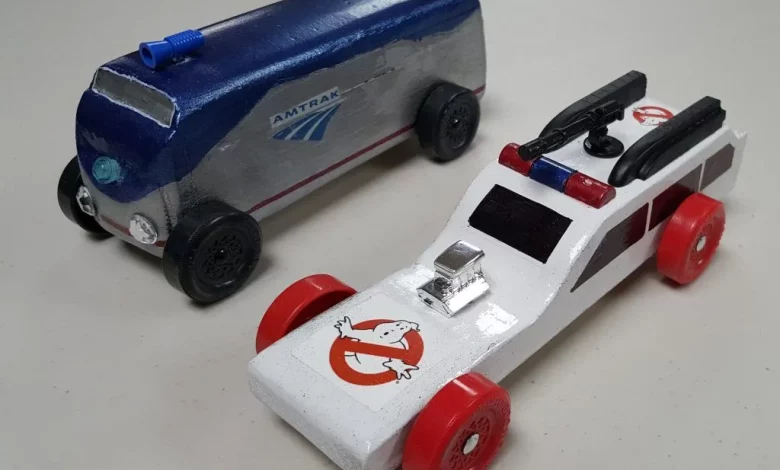
Every year since 1953, Cub Scouts in the USA have held Pinewood Derby races, where children design and launch small wooden cars powered only by gravity. Building a fast car from a wooden block helps children develop basic engineering skills and apply their STEM knowledge.
The author, Scout mum to Thomas, explains that her son took part in Pinewood Derby for many years, won numerous heats, took first place in his pack several times and represented the pack at district races. Experience brought both successes and disappointments, and the lessons learned each year helped them build faster cars. After finishing his time in Scouts, Thomas decided to share his tips with other families.
Before starting work on the car, it is recommended to look at the calendar and make a realistic assessment of the time available. Some children, like Thomas, start thinking about the design a few months before race day and work on the project gradually, while others put the car together the weekend before the race. It is important to take into account the child’s working style and the family schedule so that the process remains enjoyable rather than stressful.
The next step is to settle on an idea. Children can look for inspiration online or on specialist sites where photos of cars from previous years are published. The shape of the body affects speed: more streamlined, lower models cut through the air better. The article cites the view that a Pinewood Derby car should “push as little air as possible”, and Thomas advises making sure the car is not too tall.
The physics of the process is highlighted separately. Gravity is constantly at work on the track, but speed is affected by friction and momentum. Any unnecessary friction slows the car down, so it is important to think through the shape, and the condition of the wheels and axles. Before building, it is worth gathering materials: most packs issue standard kits, and for decoration you can use paints, stickers, Lego pieces or other things you already have at home. You also need to read carefully the rules set by the local Pinewood Derby committee, as the requirements may differ.
Once the design has been chosen, the construction stage begins. Families are advised to make a plan: what shape the body will be, which tools are needed for cutting and sanding, and how and with what the car will be painted. Thomas encourages making the car “look fast” with an interesting paint job. It is also important to divide up responsibilities: younger Lion and Tiger Scouts can sand the wooden block and hammer in the axles under adult supervision, while older Webelos can carry out more of the work themselves, drawing on their previous experience.
Safety is given particular emphasis. Adults must explain the rules for using tools and, as children grow older, give them more independence if they are confident the safety rules are being followed. On the Boy Scouts of America Pinewood Derby rules page there is a separate section with advice on working safely.
An important element of a fast car is correctly positioned weights. Various types of weights are used for Pinewood Derby: tungsten, spherical, conical, adhesive plates, moulded tungsten putty and so on. You can also use improvised materials such as coins or washers. The main thing is to build in a way to remove some weight easily if it turns out at registration that the limit has been exceeded. Thomas recommends placing most of the weight towards the centre and rear of the car, which he says helps increase speed.
Another tip is to pay attention to the details. Extra sanding of the body, extending the wheelbase, drilling holes for glue, and properly lubricating the wheels can all provide a noticeable advantage. Thomas suggests polishing the axles with sandpaper, cleaning the wheels with an old toothbrush and toothpaste, and applying fine graphite powder to the axles to reduce friction.
The author twice reminds readers of the need to reread the rules carefully before race day to avoid unpleasant surprises during the technical inspection. Even so, sometimes it is only at registration that it becomes clear a car is too heavy, too tall or too wide. Drawing on her experience working at the registration table, she notes that sometimes the adjustments are minimal, while at other times reworking the construction causes strong emotions in children.
To reduce the risk of disappointment, it is recommended to discuss the possibility of changes with the child in advance. If the car turns out to be too heavy, you need a plan for removing weight: taking off individual weights or, with the child’s agreement, drilling out some of the wood from underneath. If the car is lighter than the maximum permitted weight, the author stresses that there is no obligation to “max it out” to the limit – sometimes it is more important to preserve the intended design.
In conclusion, it is emphasised that the main aim of Cub Scouts taking part in Pinewood Derby is not only to win, but also to enjoy the process, develop engineering thinking and learn the annual lessons that come from working on a new car. Focusing on experience and learning helps make the races rewarding and joyful for the whole family.