

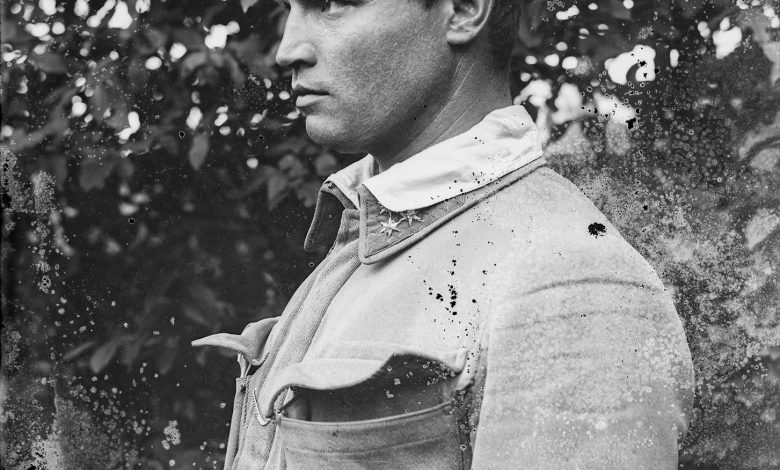
Among the figures of the Ukrainian Sich Riflemen — a formation that had deep roots in the Sokal region as well — Mykhailo Omelianovych Havrylko (1882–1920) holds a special place. He was a talented sculptor, poet, military organizer, and at the same time a man of extraordinary worldview who traveled a path from pagan beliefs to the Christian faith. His tragic death — being burned alive in the firebox of a locomotive at the Poltava railway station in the autumn of 1920 — became one of the most horrific crimes of Bolshevik terror against Ukrainian patriots.
In the well-known 1915 photograph taken in the village of Hnylche near Ternopil, Sub-Ensign Havrylko is depicted — one of the founders of the Sich Riflemen, an experienced and gifted commander.
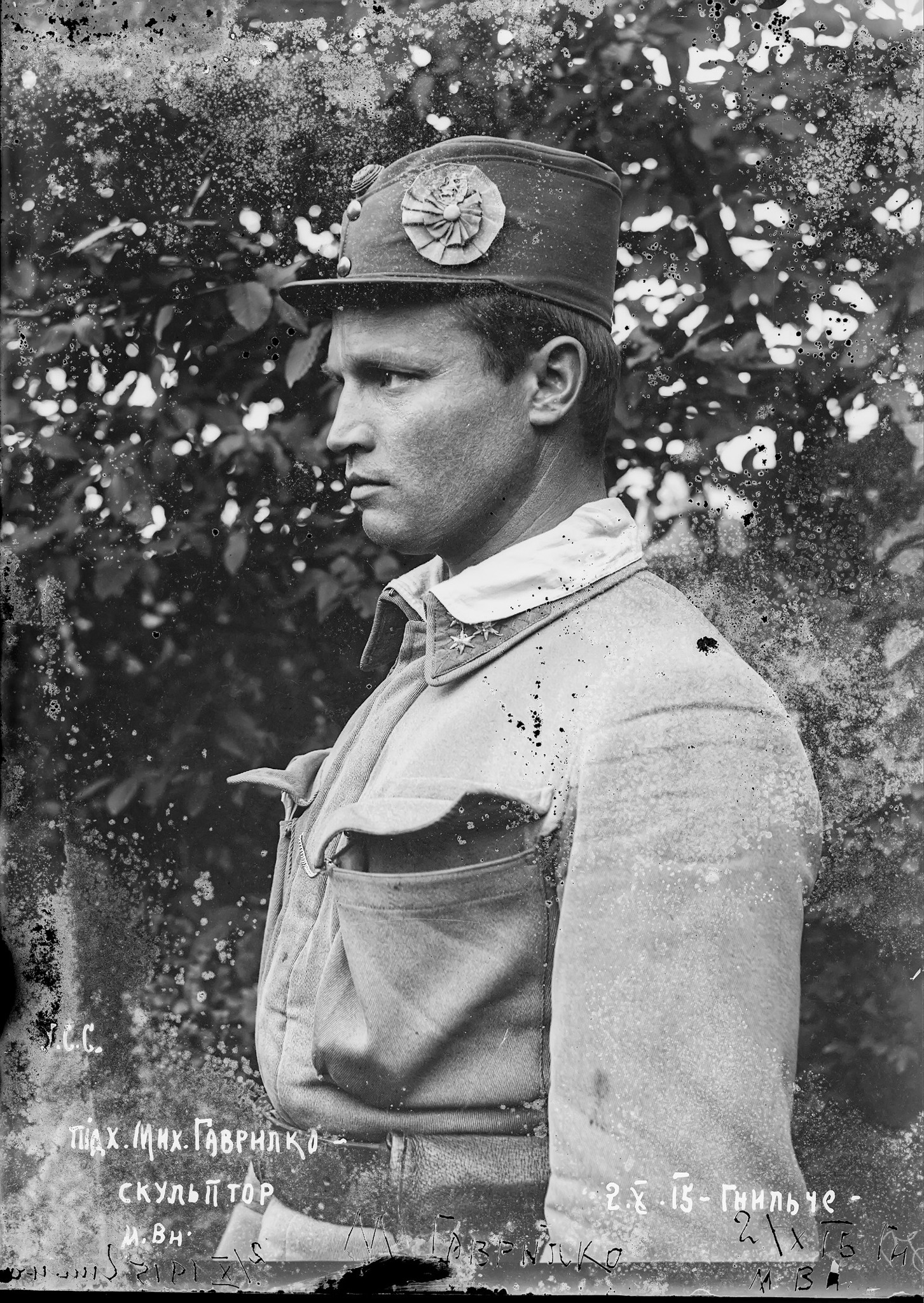
This photo was first published by researcher Vasyl Lopukh on his online resource dedicated to the Legion of Ukrainian Sich Riflemen.
It is hard to imagine that during the First World War (also read on Holos Sokalshchyny), this combat officer led his unit into attacks against Russian troops, offering prayers to Dazhboh, asking for protection for his warriors, and calling on Svaroh to destroy the enemy with lightning. Yet it was precisely such pagan beliefs that set Havrylko apart among his comrades — he sincerely believed in the power of ancient Ukrainian mythology and advocated a return to the culture of the ancestors.
Mykhailo Havrylko’s military career covered several stages of the liberation struggle. He held the post of chief of staff of the Gray Division of the Army of the Ukrainian People’s Republic — a Cossack-rifle formation created from Ukrainian prisoners of war of the Russian army in Austrian camps. Like other cultural figures of that era, Havrylko combined artistic talent with a fighting spirit. Later, he led partisan detachments in the Poltava and Chernihiv regions, everywhere demonstrating the resolve and courage of a true commander.
The rise of Mykhailo Havrylko’s life began in Galicia, namely in Lviv, where he arrived in 1907, fleeing persecution by the Russian authorities. The reason was his organization of a student strike in Saint Petersburg, where he was studying at the School of Technical Drawing. He was expelled from there with a “wolf ticket” and imprisoned. Havrylko was born on September 5, 1882, in Kozatski Khutory near the village of Runivshchyna in the Poltava region, into a family of Cossack origin.
Having settled in Lviv, Mykhailo Havrylko established close cooperation with scholars of the Shevchenko Scientific Society — one of the oldest scholarly institutions in Ukraine, founded in 1873 in Lviv. At the expense of the Society, and also thanks to a scholarship from the outstanding writer and public figure Nataliia Kobrynska — the founder of the women’s movement in Galicia — he studied at the Department of Sculpture of the Kraków Academy of Fine Arts. It was during this period that Havrylko created several designs for a monument to Taras Shevchenko, which became an important part of his artistic legacy — the so-called Shevchenkiana. Over the course of seven years, Havrylko perfected his craft in Austria and Paris in the studio of the famous French sculptor Émile Antoine Bourdelle — a student of the great Auguste Rodin, one of the most outstanding monumental sculptors of the early twentieth century.
With the outbreak of the First World War, Mykhailo Havrylko joined the “iron” platoon of the Sich Riflemen. Beginning in May 1915, he was almost continuously engaged in prolonged and bloody battles with the Russian army. The geography of his military path is impressive:
- Battles near Bolekhiv and Kalush in Prykarpattia
- Fighting near Viktoriv close to Halych and near Semykivtsi
- The defense of Tustan above the Dniester
- Clashes along the Zolota Lypa and upper Strypa — near Nastasiv and Ludvykivka
Valuable testimonies about Mykhailo Havrylko’s combat qualities have survived, published in the “Bulletin of the Union for the Liberation of Ukraine” on September 10, 1916. Centurion Dmytro Vitovskyi — one of the leading organizers of the Sich Riflemen, among whom were natives of the Sokal region — had the opportunity to observe Havrylko from May of that year and described him as a good and disciplined soldier, though inclined to argument. Vitovskyi emphasized that Havrylko, appointed commander of the pioneer unit, quickly brought order to it. Before foreign officers and even generals, he behaved freely and informally, and could easily say to a general, “My respects!” or “Adieu!”
Artist Ivanets added another touch to Havrylko’s portrait, calling him a “Naturmensch” — a man of nature with considerable innate intelligence, yet completely unreceptive to any external influences. During ten years abroad — in Austria and France — he learned almost neither German nor French, not because he lacked ability, but because his nature rejected everything foreign and non-Ukrainian. As a person, he was kind, sincere, and gentle, though firm in his convictions — satisfied with himself, yet without any pretensions.
Particularly interesting is the testimony of Lviv historian Mykola Holubets about Havrylko’s worldview. According to him, Mykhailo Havrylko opposed foreign cultural layers — Greek-Byzantine, Roman, Polish, Muscovite, and German influences — which, in his opinion, had distorted the Ukrainian soul. He passionately called for a return to the culture of the forefathers, to their gods, and to their own view of the world. Havrylko not only proclaimed these ideas at student congresses, where he spoke about Perun and the symbolism of ancient Ukrainian mythology, but as an artist and poet he also sensed the remnants of this mythology in the spirituality of ordinary people. This dreamer seriously searched for ancient Ukrainian chain mail so that he could wear it on his bare body instead of a shirt, and among all princes he recognized only Sviatoslav the Conqueror.
A fundamental turning point in Mykhailo Havrylko’s worldview came after he met Olena Hordiievska — the daughter of the parish priest of the village of Shmankivtsi in the Ternopil region, who studied in the painting department of the Kraków Academy of Fine Arts. In fact, this was a renewal of their relationship, because as early as 1912 Havrylko had sculpted her portrait. Their feelings quickly deepened, and on September 23, 1917, the newlyweds were married in the church of the village of Pisochna near Mykolaiv in the Lviv region.
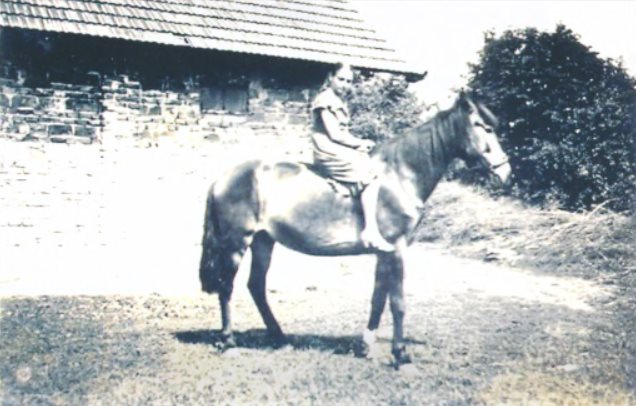
Photo from the book “Mykhailo Havrylko: With Both Stylus and Saber”
Their marital happiness lasted less than three years. The hardships of war cast 38-year-old Mykhailo Havrylko far to the east of Ukraine, where he led partisan detachments in armed struggle against the Russian Bolsheviks. As the leader of the anti-Bolshevik uprising in the Dykanka area, he was tracked down and arrested by the Cheka. In the autumn of 1920, Red Army soldiers carried out a horrific reprisal — they burned Mykhailo Havrylko alive in the firebox of a steam locomotive at the Poltava railway station.
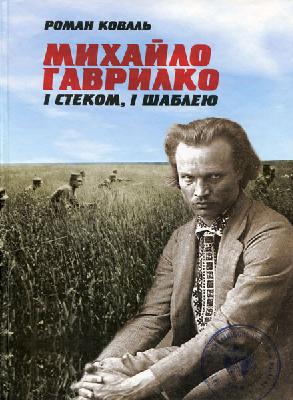
Such was the tragic fate of this heroic Ukrainian, in whose biography the personal and emotional were inseparably intertwined with the ideological and the state-building. Like the heroes of the Sokal land, Mykhailo Havrylko devoted and gave his life for the freedom of Ukraine. In Lviv, at Lychakiv Cemetery, there is a memorial plaque in honor of Mykhailo Havrylko — testimony that the memory of him is preserved in the city where his path to the Sich Riflemen began.