

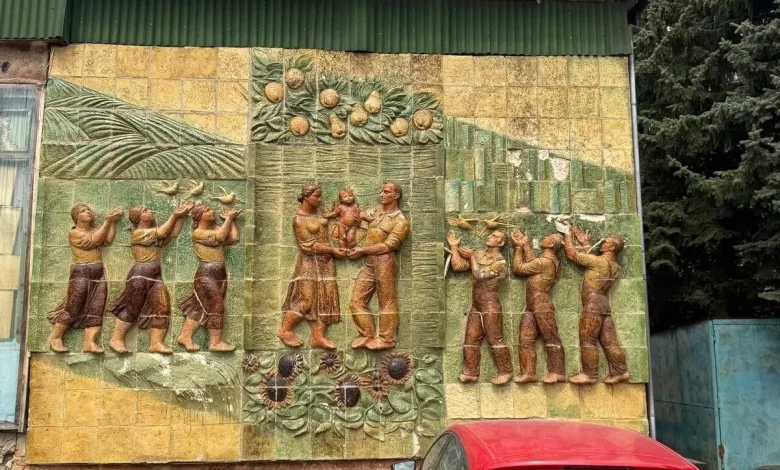
In Lviv, the 1970 ceramic panel located on the grounds of the former “Sil’mash” factory at 207 Horodotska Street has been added to the Lviv community’s Register of Valuable Mosaics and Ceramic Panels. The work is by artist Olha Bezpalkiv, a ceramic artist and member of the National Union of Artists of Ukraine.
The Soviet-era panel is mounted on the wall of the building above a brick plinth. The composition is made of square tiles in yellow-green and brown tones and is dedicated to the themes of family, labour and prosperity. The work is an example of monumental and decorative art of the 1960s–1970s, when similar compositions were actively integrated into public and industrial architecture.
According to the head of the Office for the Protection of Cultural Heritage of the Lviv City Council, Tetiana Balukova, new objects are added to the register after a professional survey and the collection of the necessary documentation. She noted that it is difficult for the Office’s staff to cover the entire territory of the Lviv community, so they are assisted by civic figures and activists who report potentially valuable works of monumental art. After an inspection, a decision is taken together with specialists on whether the object should be entered in the register.
According to Tetiana Balukova, the ceramic panel on the grounds of the former “Sil’mash” factory has survived in good condition, and the author has also been identified. Colleagues from Lviv Polytechnic completed an inventory card recording its dimensions, materials and technique. The panel was created using a relief ceramic technique with glazed modules that form a coherent plastic composition.
The figurative structure of the work is based on a narrative: depictions of people, family, labour and agrarian motifs (plants, fruit, birds) form a generalised symbolic scene characteristic of the monumental art of late modernism. The object is linked to the history of the development of Lviv’s industry in the second half of the 20th century and to the activities of the “Sil’mash” factory, one of the city’s mechanical engineering enterprises.
The Office for the Protection of Cultural Heritage stresses that inclusion in the register is only the first step towards obtaining protected status, as this requires a complex procedure. At present, documents are being prepared for submission to the Lviv Regional State Administration, after which the materials will be forwarded to the Ministry of Culture.
Tetiana Balukova noted that specialists are now actively searching for and documenting little-known objects located on the premises of factories and enterprises and often hidden from the general public. She emphasised that such works are often mistakenly perceived as elements of Soviet symbolism, although they were created by Lviv craftsmen from the ceramic factory and are an important part of cultural heritage that needs to be preserved.
The Register of Valuable Mosaics and Ceramic Panels in Lviv began to be compiled in 2019 after the high-profile destruction of the “Rybky” mosaic on the “Okean” shop. As of today, it already includes more than 80 mosaic and ceramic panels.