

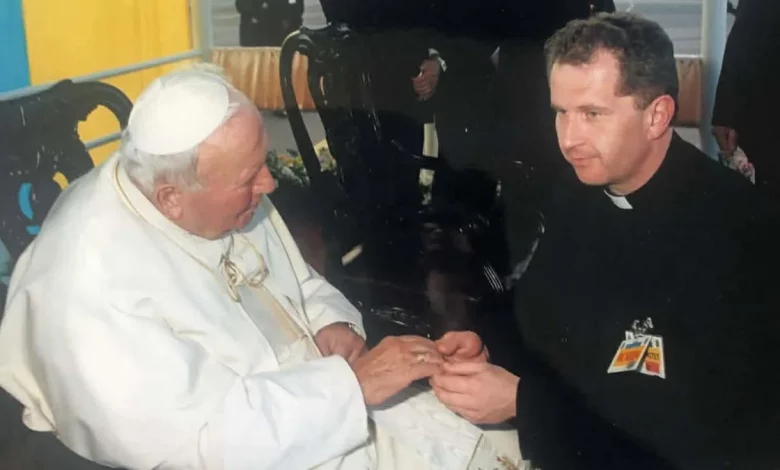
In June, Lviv marks the 25th anniversary of the historic visit of Pope John Paul II to Ukraine. From 25 to 27 June 2001, the city became the venue for one of the most important spiritual events in the history of independent Ukraine. Father Doctor Bohdan Prach, then coordinator of the visit’s organising committee and rector of the Lviv Theological Seminary, later rector of UCU, spoke about how preparations were made for the pontiff’s arrival and how he is remembered. The interview was published on the website “Dukhovna Velych Lvova” (Spiritual Greatness of Lviv).
The priest recalls that the greatest challenge during preparations was the lack of time. Information about the visit to Lviv was received only in December 2000, so the organising committee’s active work began in January 2001. It was necessary to coordinate actions quickly with state institutions and church circles, as well as to meet the Vatican’s detailed requirements regarding the safety of pilgrims and the conditions of the Pope’s stay, as he was already of advanced age and had mobility difficulties. In particular, this even concerned the exact specifications of the chairs on which John Paul II was to sit during liturgies and speeches.
According to Father Bohdan Prach, he was helped by his previous experience of taking part in organising papal pilgrimages in Poland in 1991, when the Greek Catholic Church welcomed John Paul II in Przemyśl and Lubaczów. At that time he learnt how to work with the security services, the police, municipal services and various church structures, so by 2001 he already understood the scale of the tasks facing the organisers in Lviv and Kyiv.
The priest separately highlights cooperation with the local authorities. He says that the city of Lviv immediately became actively involved in implementing projects related to the visit, and he did not feel any pressure from city or regional officials. On the contrary, they managed to build up a partnership which was maintained over many years.
An important part of the visit was the beatification of 28 new martyrs of the Ukrainian Greek Catholic Church. Father Bohdan Prach notes that the list of candidates for beatification was much broader, but the postulation committee chose those about whom there could be no doubt whatsoever. At that time access to archives was very limited; most sources were opened only under President Viktor Yushchenko. The priest himself helped to conduct the causes of three candidates for beatification.
The priest also recalled an episode connected with the blessing of the cornerstone for the new complex of the Ukrainian Catholic University. At that time they were looking for the main benefactor for the construction of the seminary, and the founder of the international charity “Aid to the Church in Need” (Kirche in Not), the Dutch monk Father Werenfried van Straaten, who knew John Paul II well, wanted the Pope himself to bless the site of the future seminary. Because of Father Werenfried’s white monastic habit, pilgrims on their way to the liturgy in Sykhiv took him for the Pope, so the organisers had to whisk him away quickly by car to avoid misunderstandings before the pontiff’s arrival.
Father Bohdan Prach also recalls personal moments of communication with John Paul II. He says the Pope knew how to focus his attention on each person he met and, even in a short time, to sense that person’s needs. The priest recounted the farewell at Lviv airport, when he approached the pontiff together with Bishop Yulian Gbur. The bishop jokingly said in Polish that Father Bohdan was the one “to blame” for the Pope’s visit, to which John Paul II smiled and replied that he would like to have more such “culprits”.
The Father Doctor pays particular attention to the Pope’s choice of language during his journey to Ukraine. He stresses that John Paul II delivered all his official speeches in Ukrainian, switching into Polish only occasionally for certain quotations or passages. In his view, this was a clear sign of respect for Ukraine, Ukrainians and the Greek Catholic Church, which had gone through persecution and martyrdom. The Pope also emphasised the need for Christian reconciliation between Ukrainians and Poles.
Among the most eloquent moments of the visit, Father Bohdan Prach names the liturgy in Sykhiv, where, despite heavy rain the day before, hundreds of thousands of faithful gathered. After the Pope’s blessing, he says, the sun came out. The priest also recalls John Paul II’s well-known phrase that “the rain falls, the storm comes, and the children will grow”, which he regards as prophetic words about the trials that still awaited Ukraine but were not to break its future.
In Father Bohdan Prach’s conviction, the Pope’s main message to Ukrainians was respect for their own history, language and culture. John Paul II reminded them of the example of previous generations who, in far more difficult circumstances, preserved their dignity, worked for the state, held fast to Christian values and did not allow the Ukrainian people to be divided.
The priest is convinced that John Paul II’s visit had a significant impact on Ukraine’s subsequent development. He believes that without the courageous words of hope which the Pope instilled in people’s hearts, later events, including the Orange Revolution and the Maidan, might have taken a different course. In his opinion, today, in wartime conditions, Ukrainians should once again turn to John Paul II’s sermons and rethink their messages.
To mark the 25th anniversary of Pope John Paul II’s visit, almost a hundred spiritual, cultural, artistic and youth events have been prepared in Lviv. These include festive liturgies, film screenings, a cycling pilgrimage, the “Pope–Youth” flash mob, photo exhibitions and the issuing of a commemorative postage stamp.