

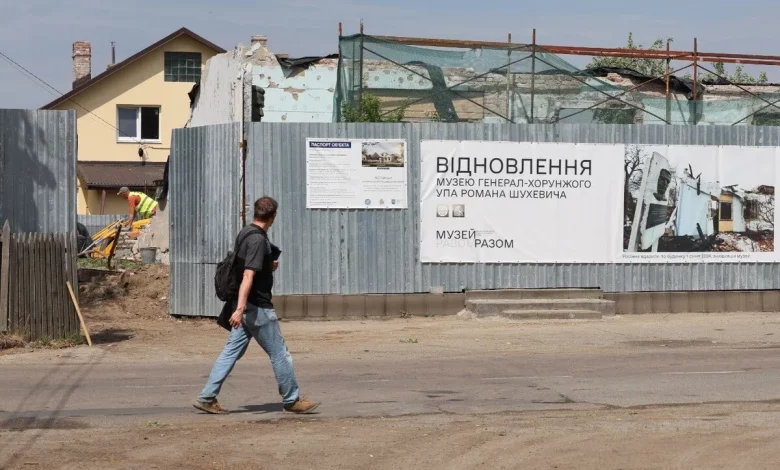
During the reconstruction of the museum of UPA Brigadier General Roman Shukhevych in Bilohorshcha, workers discovered a stone-lined underground room in the building’s foundations. Historians are now studying its possible purpose, according to Lviv City Council.
The room measures roughly 4 by 2.3 metres and is almost 2 metres deep. It is located right by the entrance to the museum and had been completely filled in with earth. During the excavation archaeologists did not find any valuable historical artefacts, but they did uncover items from the Soviet period – old bottles and other small objects.
According to the Chief of Staff of Lviv City Executive Committee Yevhen Boyko, archaeological evidence suggests that the room may be a hideout used by Roman Shukhevych for security purposes. It was previously known that there was another hideout between the first and second floors of the building, which is to be restored. The newly discovered underground room is to be included in the museum’s future exhibition as a separate feature.
Work to restore the Shukhevych museum began in early March. Preparatory work was carried out first, and the foundations were carefully cleared, as the museum is a heritage site. According to Yuriy Telipskyi, Director of the LCP ‘Lviv Intercity Technical Inventory Bureau’, the building’s base was cleared as carefully as possible in order to strengthen the foundations and preserve the brickwork of the original structure. Bricks preserved and conserved after the museum’s destruction are being used in the reconstruction to restore the building’s original volume. A metal roof frame has already been ordered, and its fabrication will take about a month.
The discovery of the probable hideout has somewhat delayed the construction schedule, as research had to be carried out and the conclusions of the archaeological service awaited. Despite this, the plan is to erect the walls and roof the museum by the end of June, so that by Roman Shukhevych’s birthday the main outlines of the restored building are visible.
Once the project is completed, the museum’s floor area will almost double. The grounds will also be extended by nearly 10 sotkas, to be used as a public space for educational purposes. The restoration comprises two stages: reconstruction of the destroyed museum building together with an ancillary structure, and a separate landscaping project for the area opposite. The LCP ‘Institute for Spatial Development’ is working on the design of the public space, with the Railway District Administration acting as the contracting authority.
In front of the museum, plans include restoring the pond, installing street furniture, creating a car park and improving the area around the monument to Roman Shukhevych. The future exhibition is being developed by the NGO ‘New Museum’ together with the historical museum.
The project to rebuild the Shukhevych museum, destroyed by Russian shelling on 1 January 2024, is the first instance in Ukraine of a museum institution being restored during the full-scale war. 80% of the funding was provided by the VAM shopping centre chain and its partners. An additional more than 3 million hryvnias was raised in charitable donations from Lviv residents, staff of Lviv City Council and the city’s cultural institutions to fit out the exhibition. Among those contributing to the fundraising was Oleksandr Usyk, while colleagues from Japan financed the restoration of the staircase.