

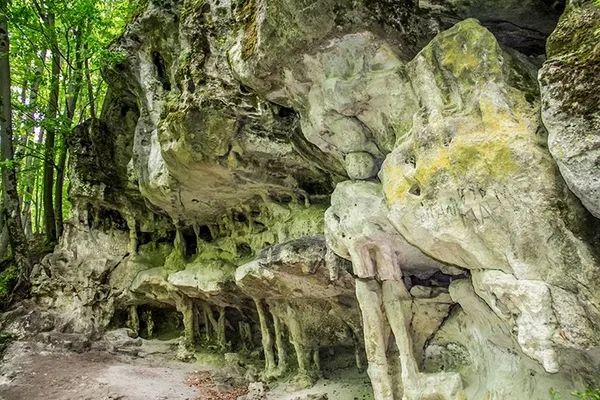
The Department of Sport, Youth and Tourism of the Lviv Regional State Administration has presented a selection of rock formations in Lviv Region, located in various municipalities across the area. These are sites with caves, ancient settlements, rock-hewn monasteries and panoramic views that could become standalone tourist routes.
In addition to the well-known Tustan, the region has dozens more atmospheric rock massifs. The selection includes seven such places, most of which combine natural uniqueness with historical and archaeological value.
The Stilsko hillfort near the village of Stilsko in the Mykolaiv municipality is considered by archaeologists to be among the largest proto-cities in Europe of the 8th–11th centuries. According to one theory, it might have been the capital of the White Croats. The complex includes a fortified hillfort with ramparts, surrounding settlements, caves, altars, burial mounds, rock formations and the so-called “White Road”. One separate feature is the “Dyriavets” stone, associated with ancient cults.
In the village of Rozhirche in the Stryi municipality there is a preserved rock-hewn monastery, carved out of sandstone. Narrow steps lead up to the stone church. Researchers believe the monastery could have appeared as early as the 10th century, and that the caves themselves were used by people even before the spread of Christianity. There are ancient symbols and inscriptions on the walls, some of which remain undeciphered.
Near the village of Tyshivnytsia in the Skole municipality are the Kniazhi Rocks, sandstone formations around 70 million years old. Individual massifs reach about 40 metres in height. The best known of them are called Khanska, Kniazha and Yaroslavna, and are linked with legends about Tatar raids on Rus’ lands.
Another Skole area location is the Easter Island Rocks near the village of Kamyanka. They received their unofficial toponym because the shapes of the stone blocks resemble the figures from Easter Island. The rocks are surrounded by forest and mountain slopes; nearby are Mount Kliuch, the Kamyanetskyi Waterfall and Zhuravlyne Lake, which makes it possible to create a one-day walking route.
In the village of Yamelynytsia in the Skole municipality are the Yamelynytsia Rocks, comprising a number of separate massifs with their own names, including “Pyshchyk”, “Stina”, “Shyiatyi”, “Yushkova Yama”, “Kykoshiv Kamin”. The most famous is “Aphrodite of Yamelynytsia”. During the UPA era, the “Aphrodite” radio station operated at this site, broadcasting in four languages.
Near the town of Mykolaiv in the Mykolaiv municipality is the Pryima Grotto, known as one of the most ancient sites of prehistoric humans on the territory of Ukraine. Archaeological research indicates that the site is associated with Neanderthals and dates back to roughly 45 thousand years ago. The grotto lies in woodland amidst rocks and gorges.
In the urban-type settlement of Pidkamin in the Pidkamin municipality, the dominant feature of the landscape is a large inselberg rock about 16 metres high, from which the settlement takes its name. It is known as the “devil’s stone” and is shrouded in local legends. Nearby are an old fortified monastery, an ancient cemetery with Cossack crosses and viewpoints over the Medobory.
The Department of Sport, Youth and Tourism of the Lviv Regional State Administration stresses that the rock formations of Lviv Region combine natural landscapes, historical monuments and elements of ancient cults, yet remain little known to mass tourism, which makes them promising for new routes and research.