

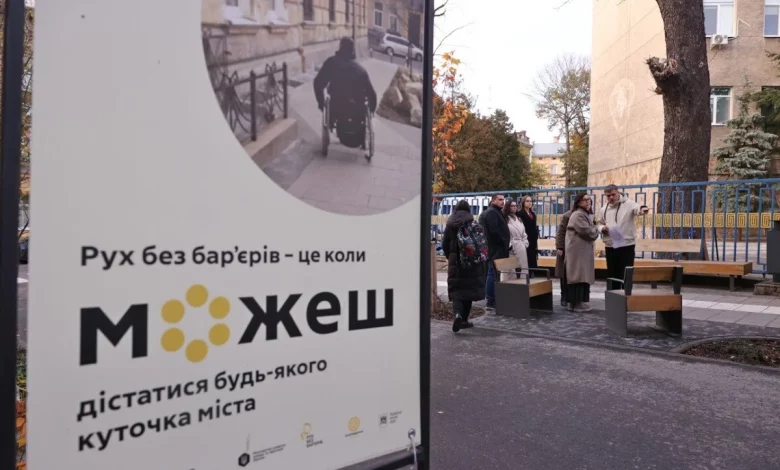
In the Lychakivskyi district of Lviv, work continues on creating an accessible medical and educational quarter, which concentrates more than 160 medical, educational and social institutions within an area of 1.6 km². Step by step, a space is being formed here where people with disabilities, patients after injuries, older people, service personnel, students and medical staff can move without obstacles from a stop to a hospital, pharmacy, educational institution or public space.
The district is home to the Military Hospital, the Border Guard Service Hospital, Lviv National Medical University, the Regional Clinical Hospital and a diagnostic centre. A new building for the UNBROKEN centre and the UNBROKEN Art arts and rehabilitation centre are also under construction here, and nearby is Lychakiv Cemetery, where fallen soldiers are buried and where a Memorial to the Heroes of Ukraine is planned. According to the head of Lychakivskyi district, Yurii Lukashevskyi, this is precisely where the largest number of people in need of a comfortable and accessible urban environment are concentrated.
The transformation began with a project to refurbish a neglected square at the junction of Chernihivska and Sevastopolska streets. Following consultations with the management of the Military Hospital, an inclusive eco-space was created here: pavements were repaired, lighting installed, the area landscaped and street furniture added. More than 10,000 euros in grant funding was raised for this within the framework of the project “Integrated Urban Development in Ukraine II” of the German federal company GIZ, supported by the governments of Germany and Switzerland. A symbolic honey locust tree was planted in the square in memory of four fallen defenders who had lived in neighbouring buildings.
After this, the streets Verkhratskoho, Sevastopolska, Chernihivska and Patriarkha Yaremy were refurbished and made more accessible, forming a single network of routes for patients and medical staff. One of the key steps was the major overhaul of the main entrance area of the Military Hospital and Kravchuka Street: new pavements, landscaping and rest areas were created here. Using private funds, the dangerous perimeter fence of the hospital along Chernihivska Street was replaced. With support from the Icelandic Ramp Up fund, accessible entrances have been installed at 58 buildings in the Lychakivskyi, Halytskyi and Frankivskyi districts, and work is ongoing.
In the buildings of the medical and educational quarter, eight unsafe balconies have been repaired together with residents under the city co-financing programme. Entrepreneurs are also actively involved: around 80 businesses operate in the neighbourhood, and more than half have already improved the accessibility of their premises by investing in pavement repairs, convenient entrances, call buttons for staff, handrails, ramps and lifts.
Among the key tasks for 2026 is a major overhaul of part of Yu. Ruf Street from Mechnykova to Chernihivska. On the section between Skovorody and Karmeliuka streets, an inclusive space is planned that will link the public transport stop, the medical university and the entrance to the Regional Clinical Hospital. GIZ has provided 200,000 euros for this, and a team of Ukrainian and German specialists is working on the concept.
Work will continue on refurbishing the pavement on K. Levytskoho Street, including a cycle lane to provide a convenient connection with the city centre and link the Military Hospital, the dental department and the Lychakivskyi District Administration. On Ivasiuka Street, where the pavements are in critical condition, the odd-numbered side will be repaired as a priority, accessible entrances to building entrances will be installed and green areas restored. In the building of the Lychakivskyi District Administration at 67 K. Levytskoho Street, which houses the Administrative Services Centre (TsNAP), the Pension Fund, the Social Protection Department and the Dzherelo social services centre, a lift is planned to ensure access to all floors.
This year, the first “Viennese”-type tram stop in Lviv will appear next to the Military Hospital. Part of the carriageway in the passenger boarding area will be raised to pavement level, making it easier for wheelchair users, parents with pushchairs and other people with limited mobility to board the tram. The raised section will also force cars to slow down, improving road safety. A small public space for residents and hospital patients is planned at this location.
Within the quarter, two more major inclusive public space projects are planned. The first is a square at the junction of Chernihivska and Pekarska streets (working title – Military Medics’ Square), which will provide an accessible route linking the new UNBROKEN centre building, the Military Hospital, the Diagnostic Centre and the Regional Hospital. It will feature children’s and inclusive sports playgrounds, rest areas with street furniture, as well as “islands” with medicinal plants and underground tanks for collecting rainwater for technical use.
The second project is a modern public space on Tershakovtsiv Street with a children’s playground, green areas, sculptures and a cycle lane. It is intended to become a convenient recreational area for visitors to social, administrative and medical institutions, as well as for local residents.
There is no separate budget for creating the accessible medical and educational quarter. Funding is being raised step by step from the city and state budgets, from international partners, businesses and residents. According to Yurii Lukashevskyi, the work is being carried out “in targeted spots”, guided by an overall concept for the development of the quarter, which makes it possible to gradually transform the space and already provide people with accessibility.
Lviv is taking part in the national initiative “Movement without Barriers”, implemented jointly with the Ministry for Communities and Territories Development. The city is creating accessible routes not only in Lychakivskyi, but also in Shevchenkivskyi district, where a new footpath is being built to Zamartynivskyi Park, an accessible space is being created near residential buildings on Mykolaychuka Street, Vira, Nadiia, Liubov Street is being repaired and a “therapeutic garden” is being created for patients of the UNBROKEN rehabilitation centre.
Overall, within the framework of the “Movement without Barriers” project, Lviv is developing a route almost 15 km long that will connect the Shevchenkivskyi and Lychakivskyi districts. Along it, buildings, stops, parks and public spaces are to become fully inclusive, and in planning, particular attention is paid not only to technical solutions but also to creating spaces for recovery and therapy.