

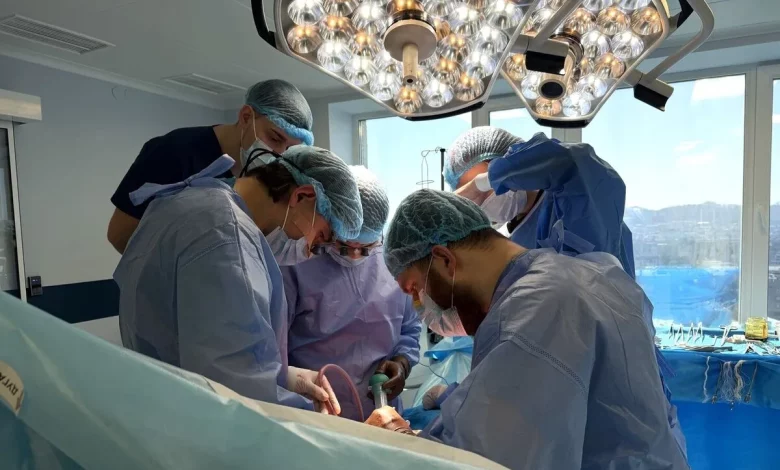
In Lviv, doctors at St Panteleimon Hospital, together with specialists from the Shalimov Institute, carried out an extremely complex 12-hour liver operation on a 55-year-old man with severe parasitic damage to the organ.
The patient, Mr Lyubomyr from the Lviv region, was diagnosed with hepatic alveococcosis — a disease caused by a parasite that attacks and destroys the liver and blood vessels, and then spreads to neighbouring tissues and organs. The parasite had affected 6 of the 8 liver segments, the left middle and right hepatic veins, the inferior vena cava, the right and left portal veins, the right bile duct and partly the left one, as well as the diaphragm, reaching the area of the pericardium.
Five years ago, the man suddenly became jaundiced and, after an examination, was given a preliminary diagnosis of terminal-stage liver cancer. At that time, doctors believed that nothing more could be done. Later in Kyiv, he was given a different diagnosis — alveococcosis. Initially, a liver transplant was considered his only chance of survival, but a donor did not appear for a long time and the patient’s condition deteriorated.
Specialists at the Department of Liver and Bile Duct Surgery of the Transplantology Centre of the First Medical Association of Lviv then decided to perform radical surgery to remove all the affected areas. According to the head of the department, Oleh Huziy, liver resection in this case carried very high risks, so colleagues from the Shalimov Institute were brought in for the procedure.
As explained by Oleksandr Hrynenko, head of the Department of Liver Transplantation and Surgery at the Shalimov Institute, during the operation the liver was temporarily disconnected from the blood circulation and cooled with a special preservation solution to protect its tissues. The surgeons then resected six liver segments. Because one of the segments had increased significantly in size over the course of the disease, the surgeons were able to remove a large volume of affected tissue radically while preserving the function of the organ.
The next stage was reconstruction of the left hepatic vein, the inferior vena cava and the left portal vein, as well as reconstruction of the bile ducts. The procedure was completed with reconstruction of the diaphragm, as the parasite had invaded it and spread towards the pericardium. The operation lasted almost 12 hours, and as a result the doctors managed to remove the parasitic lesion radically while preserving the patient’s own liver.
Until now, similar highly complex operations in Ukraine had been performed only in two medical institutions in Kyiv, including the Shalimov Institute, where no more than 6–7 such procedures are carried out each year. For Lviv and the western regions of Ukraine, this is the first operation of this level performed at the First Medical Association of Lviv.