

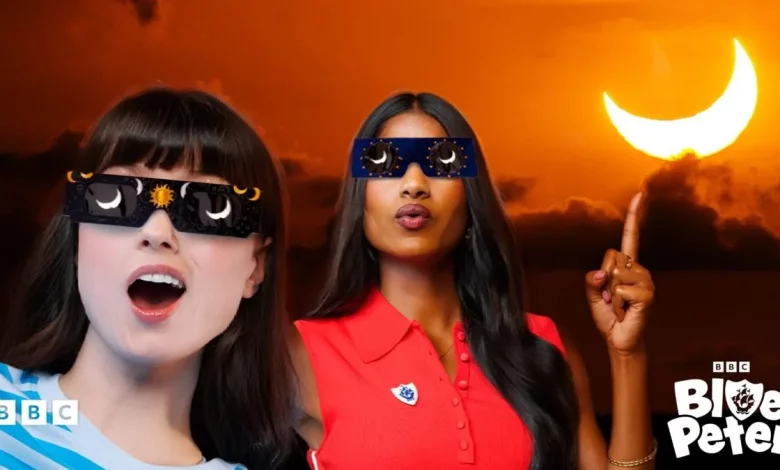
On Wednesday 12 August 2026, people in the United Kingdom will be able to see the most spectacular solar eclipse since 1999. The Moon will cover up to 96% of the Sun’s surface, depending on the region of the country, and a bright fiery crescent will be visible in the sky. The event will take place in the evening, roughly from 18:00 to 20:00 local time.
Astronomers emphasise: you must never look at the Sun with the naked eye. To observe the eclipse you must use proper eye protection or indirect image projection methods.
That same day, later at night, the Perseid meteor shower will reach its peak. So on 12–13 August you can look forward to a “double” astronomical event: first a partial solar eclipse, followed by a display of shooting stars, provided the sky is clear.
Special eclipse glasses look similar to cardboard 3D glasses, but contain powerful filters that block harmful radiation. Ordinary sunglasses are not suitable for this purpose. The product must carry the ISO 12312-2 safety standard marking (the ISO 12312-2:2015 certificate is recommended), confirming that it is suitable for observing the Sun.
Before use, these glasses should be carefully inspected: if there are scratches, tears or even tiny holes, they must be thrown away and not repaired. Put the glasses on before you look up at the Sun, and take them off only after you have turned away.
Those who do not have special glasses can use indirect methods. The simplest option is a pinhole projector. You will need two sheets of white paper or card, and a pin or other sharp object to make a small hole about 3 mm across. Make a small clean hole in the centre of one sheet, stand with your back to the Sun, hold the card with the hole so that sunlight passes through it, and use the second sheet as a “screen”. A reduced image of the Sun will appear on it, which will turn into a crescent during the eclipse.
Another indirect viewing method is to use a colander. If you stand with your back to the Sun and hold the colander so that the light passes through the holes onto a white wall or a sheet of paper, each hole will create a tiny projection of the Sun, and during the eclipse you will be able to see a multitude of miniature solar crescents.
Experts warn about a number of hazardous actions that must be avoided. It is unacceptable to watch the eclipse through ordinary sunglasses, even if you wear several pairs at once. Likewise, you must not observe the Sun through cameras, telescopes or binoculars without special solar filters fitted in front of the lens – the optics intensify the radiation and can damage your eyesight in an instant.
Cloud cover does not make observing any safer either: even through thin cloud enough harmful light still gets through. You should also not look at the Sun via your phone screen while trying to take a photo, as you can accidentally catch a direct ray in your eye and also damage the camera if it is not protected by a filter.
The approximate eclipse times for major UK cities will be as follows (all data in British Summer Time):
- Edinburgh: 18:08 to 20:00, maximum coverage 90.7%, peak around 19:05;
- Glasgow: 18:08–20:00, coverage 91.4%, peak 19:06;
- Belfast: 18:10–20:03, coverage 93.1%, peak 19:08;
- Leeds: 18:12–20:03, coverage 90.8%, peak 19:09;
- Manchester: 18:13–20:03, coverage 91.4%, peak 19:10;
- Liverpool: 18:13–20:04, coverage 91.8%, peak 19:10;
- Sheffield: 18:13–20:03, coverage 91%, peak 19:10;
- Birmingham: 18:15–20:05, coverage 91.8%, peak 19:11;
- Cardiff: approximately 18:16–20:07, coverage 93.2%, peak 19:13;
- London: around 18:17–20:06, coverage 91.4%, peak 19:13.
The greatest degree of obscuration is expected in the Cardiff area – about 93%. In south-western regions, including near Land’s End in Cornwall, the eclipse may reach about 95.6% coverage of the Sun’s disc.
As the event will occur before sunset, the Sun will be low above the horizon. For a better view, it is advisable to choose in advance a spot with an open western to north-western horizon – a hill, open park or beach. You should arrive at your chosen location at around 17:30 to set up your equipment in good time before the eclipse phase begins at roughly 18:00, with maximum coverage between 19:10 and 19:15.
The synoptic forecast, according to BBC Weather as of 7 August, indicates hot and sunny weather with a light breeze for the day of the eclipse, but meteorologists remind us of the changeable British climate and advise keeping an eye on forecast updates.
On the night of 12–13 August, the Perseid meteor shower associated with the trail of comet Swift–Tuttle is expected to reach its maximum. This time conditions will be particularly favourable thanks to the dark, moonless sky immediately after the eclipse, increasing the chances of seeing numerous “shooting stars” around midnight.