

Sokal Embroidery: From Black Silk to Ukraine’s National Treasure
On the banks of the Western Bug, in the very heart of the Nadbuzhanshchyna region, a unique art was born that is now recognized as an element of Ukraine’s intangible cultural heritage. Sokal embroidery is not merely an ornament on fabric. It is the encoded language of generations, black-and-white poetry of threads, in which pain and wisdom, beauty and resistance, antiquity and modernity are intertwined.
When you hold an authentic Sokal shirt from the late 19th century in your hands — fine linen cloth with neat black cross-stitches — you can feel time speaking through the fabric. These shirts were created by women who did not know the word “design,” yet intuitively built compositions worthy of museum walls. And today, in 2025, the Sokal shirt has officially been included in the National List of Elements of Ukraine’s Intangible Cultural Heritage — a recognition awaited for decades.
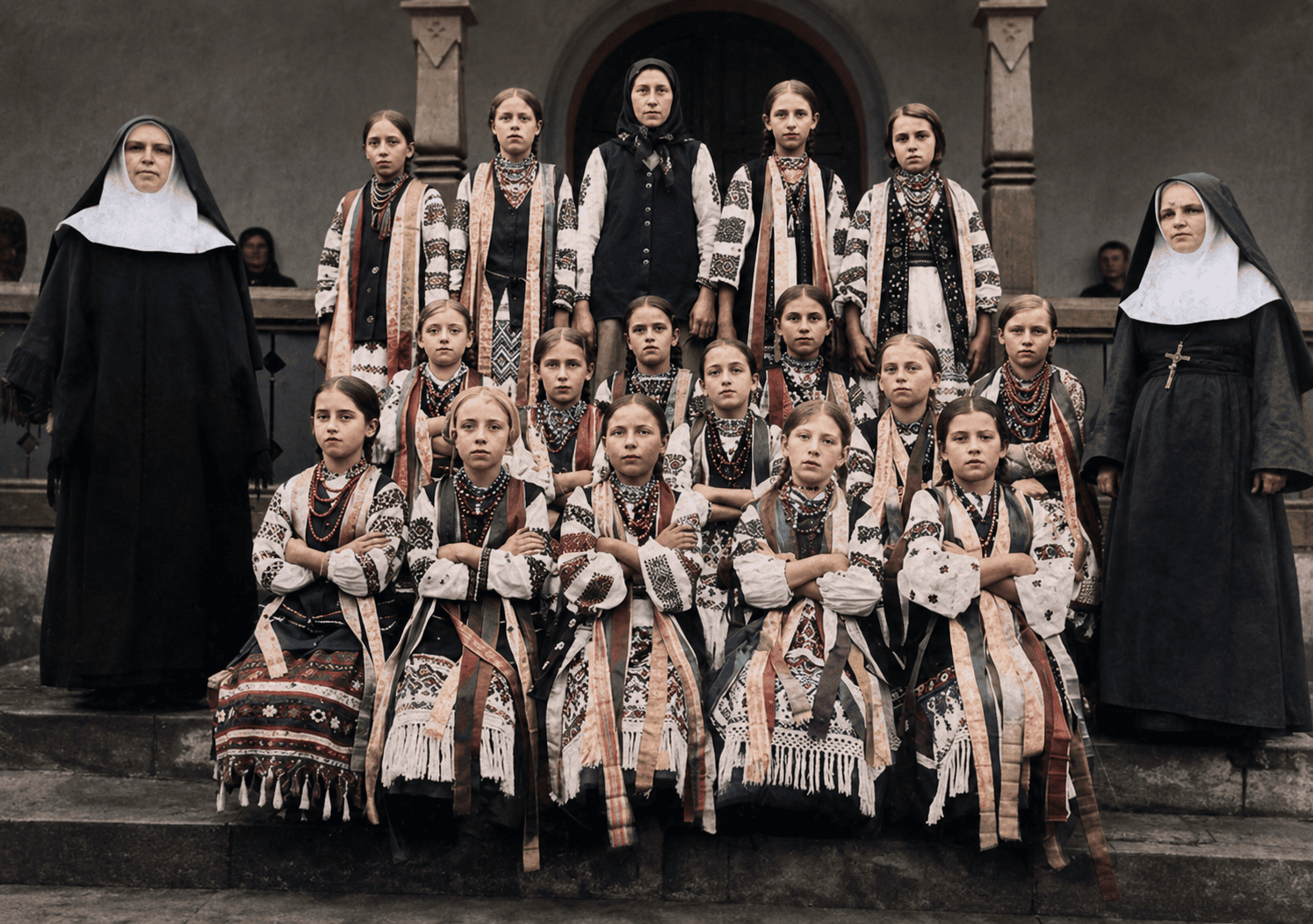
The article uses photographs from private collections and, alongside them, color versions that were created based on the original photograph and the history of Sokal embroidery. The color photographs do not reflect the actual color palette and are only a projected version.
Where Sokal embroidery was born
Sokal embroidery is not a purely urban phenomenon limited to the walls of ancient Sokal. Its area is much broader. This art covers the entire territory of Nadbuzhanshchyna — the lands on both sides of the Western Bug River in northern Lviv region, southern Volyn, and adjacent territories of modern Poland. The Sokal territorial community, which is the main center where the tradition is practiced, unites 60 settlements, where each village had its own local features of patterns.
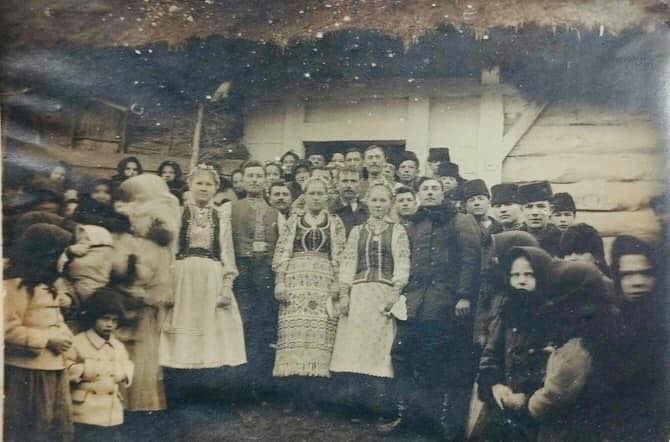
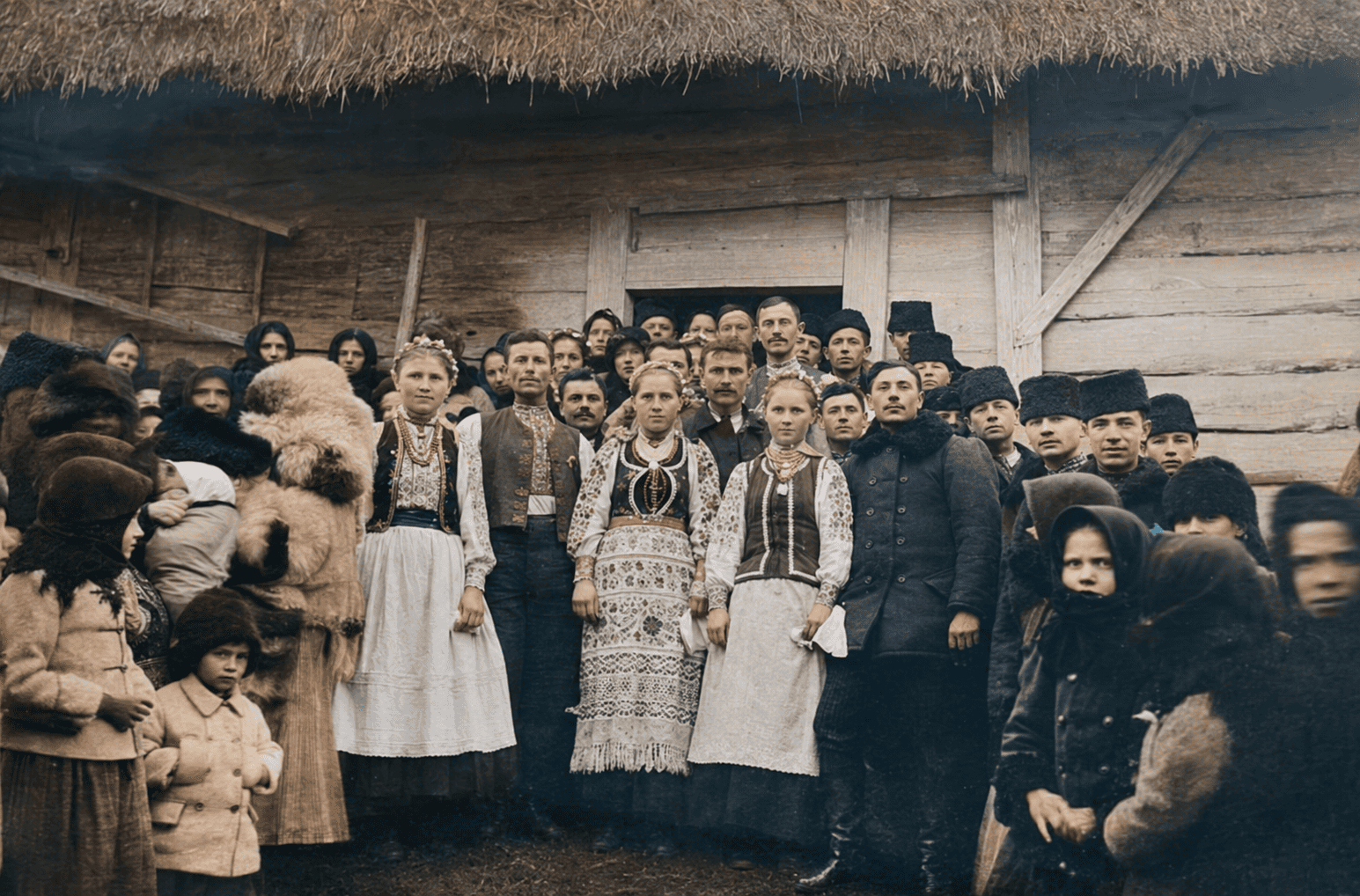
The well-known researcher Mariia Dolinovska, who has collected a collection of hundreds of authentic Sokal shirts, emphasizes that it would be more accurate to speak of a “Prybuzhanshchyna” embroidery culture, since similar traditions existed from Hrubieszów in modern Poland all the way to Ustyluh in Volyn. This large territory, close to the Western Bug and its tributaries, created a single cultural space with a shared visual language.
Sofiia Chekhovych, in her fundamental work “Folk Art of the Sokal Region” (1957), wrote that embroidery was practiced literally in every village and town of the Bug region. It was not entertainment, but an integral part of women’s everyday life — a girl prepared embroidered shirts for her wedding, and the quantity and quality of the embroidery testified to her skill and diligence.
Why black: the mystery of the color
The main visual feature of Sokal embroidery that makes it recognizable among dozens of other regional traditions is its monochrome character. Black threads on white or unbleached linen create a contrast reminiscent of refined graphic art.
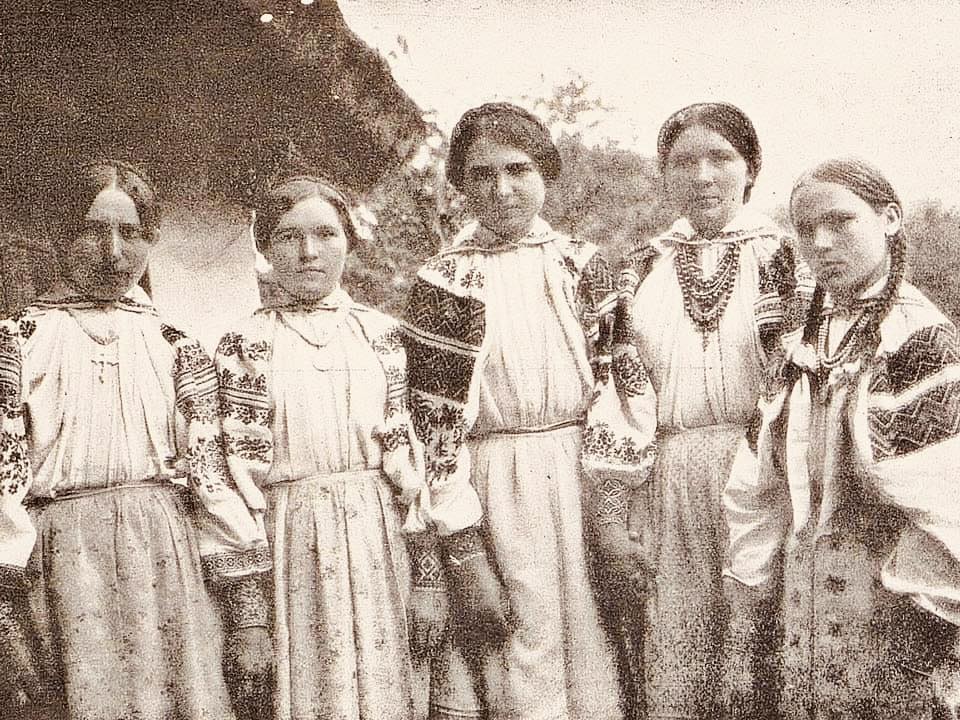
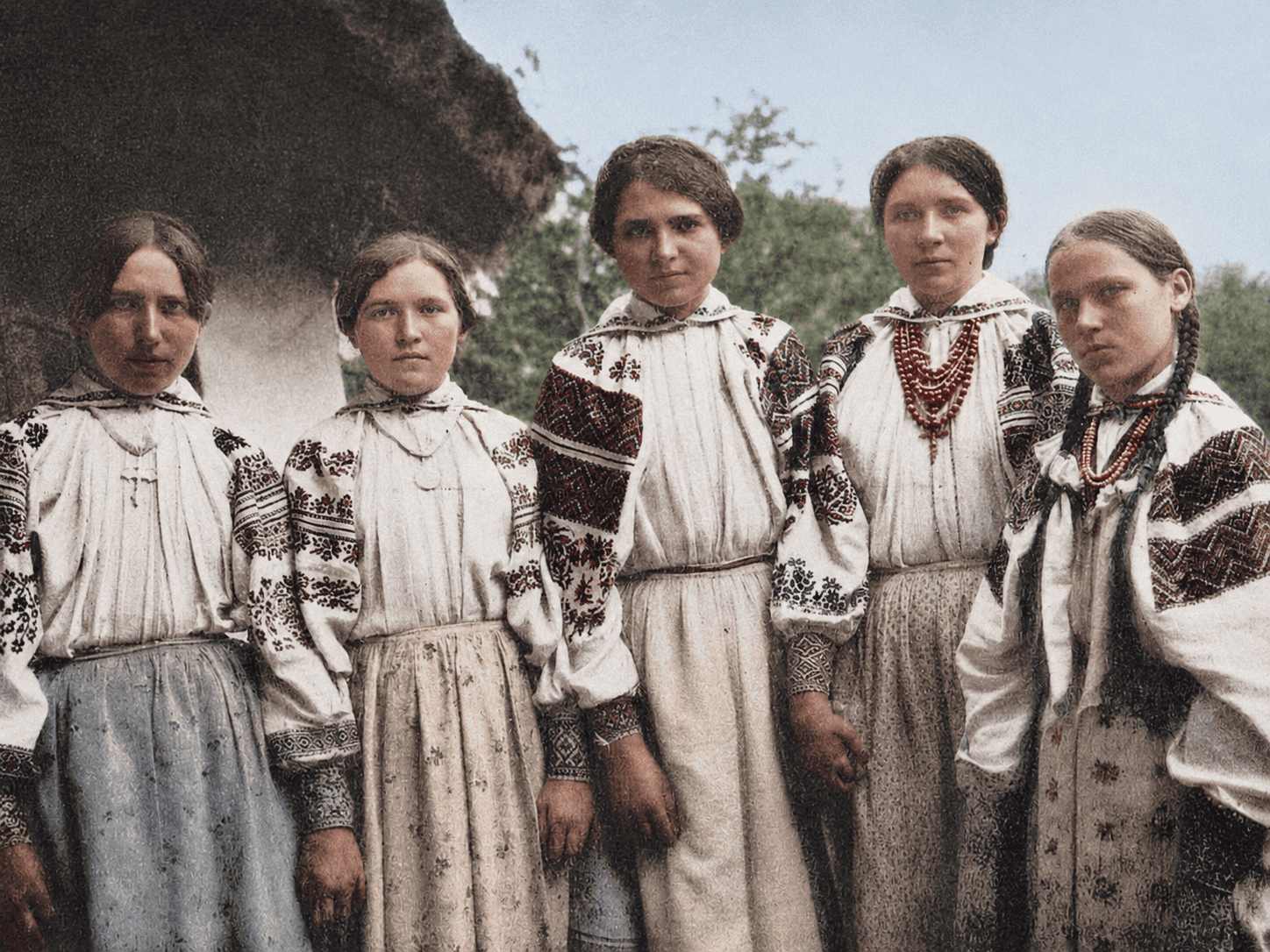
There are several versions of the origin of this tradition, and none of them is definitive. The most romantic is the legend of the Mongol-Tatar invasion, after which the women of the Sokal region supposedly wore mourning by embroidering in black. According to legends, the “Black Road” passed through Sokal, along which captive girls were taken into slavery. However, most modern researchers are skeptical of this version.
As Vira Chypurko notes in her interview with the publication “Holos z-nad Buhu”, the author of the fundamental study “Chornotsvit,” the black color in the embroidery of the Sokal region is above all an aesthetic choice. The black-and-white ornament is elegant and classic at the same time; it suits any clothing and situation. The collector Mariia Dolinovska adds another argument: embroidery in black was not because of the Tatars, but because of the desire to emphasize local distinctiveness.
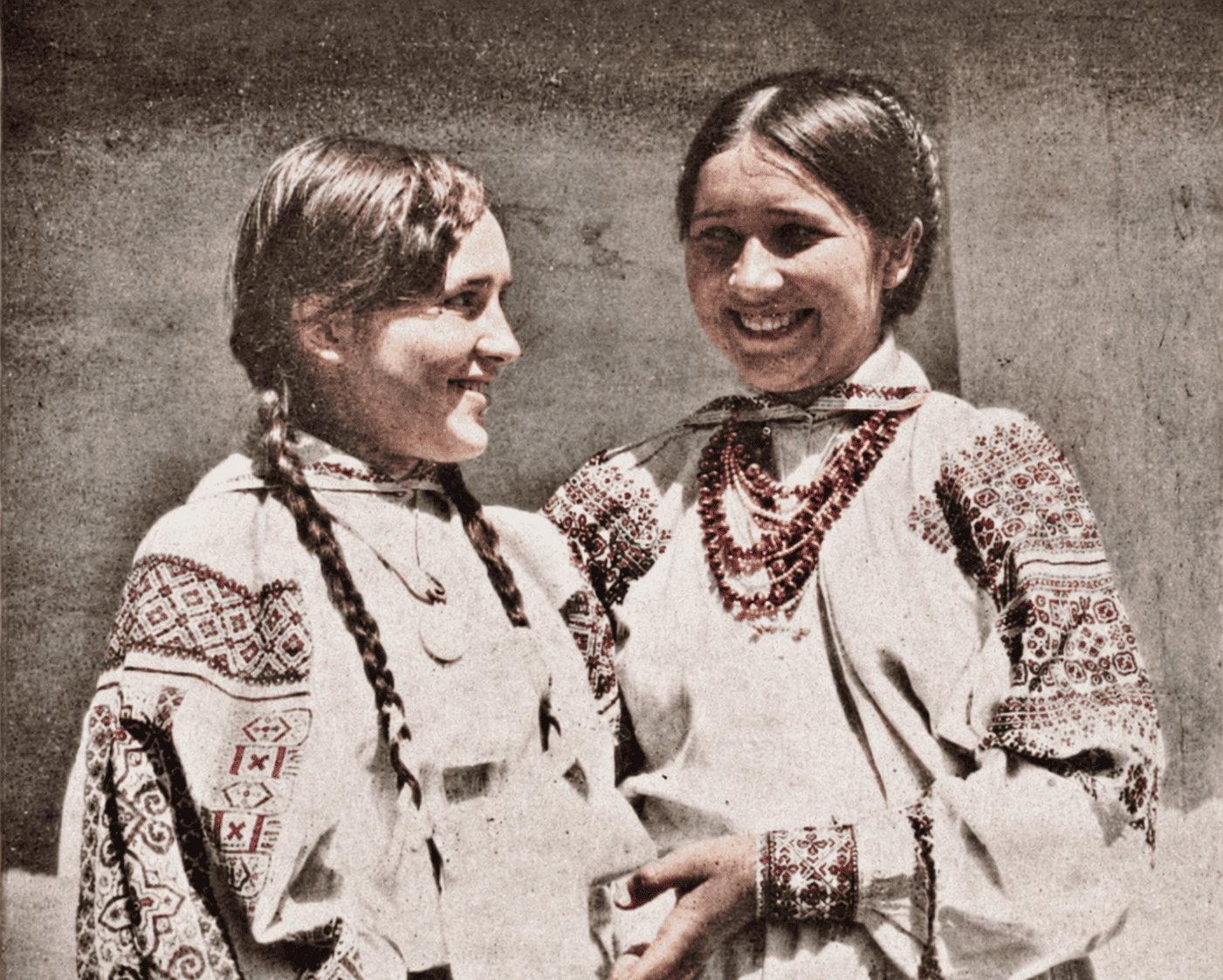
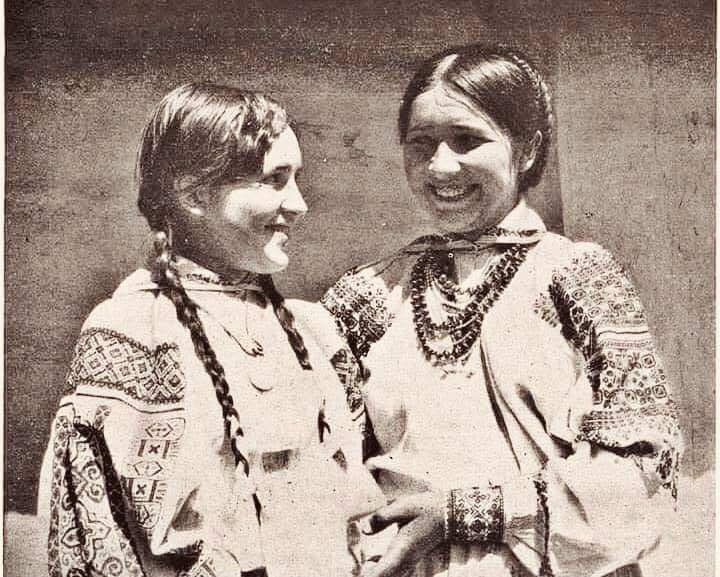
It is important to understand that black was not the only color. According to Bronisław Sokalski, the author of the book “Sokal County from a Geographical, Ethnographic, Historical and Economic Perspective” (1899), embroidery among the people of Sokal was “geometric, with a small pattern, in black or red, or both together, sometimes with the addition of yellow”. In other words, monochrome black embroidery is only one of the variants, although it is the most characteristic and recognizable.
The evolution of ornament: from geometry to flowers
Sokal embroidery underwent a profound transformation over the past 150 years, and this process has been clearly documented by researchers.
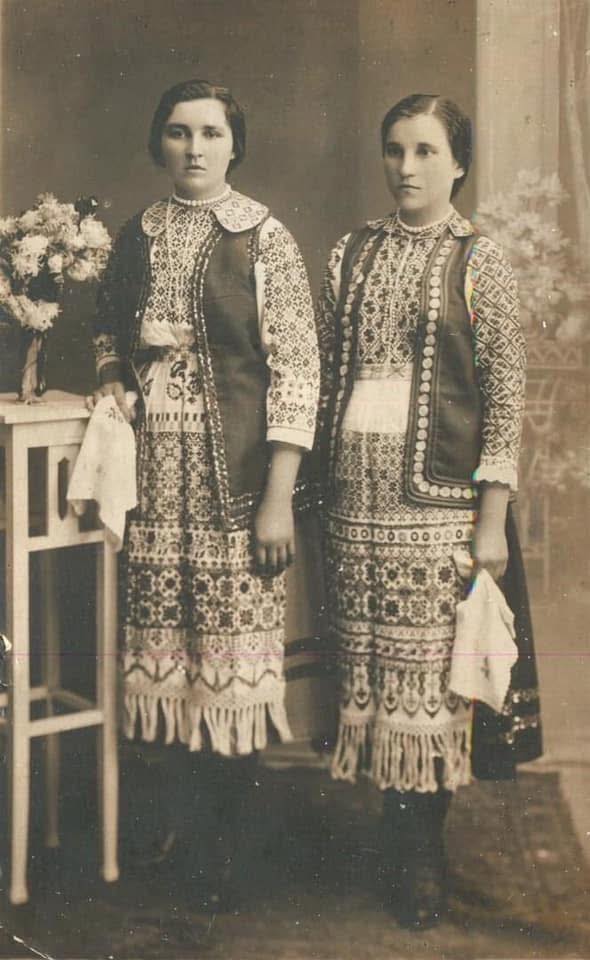
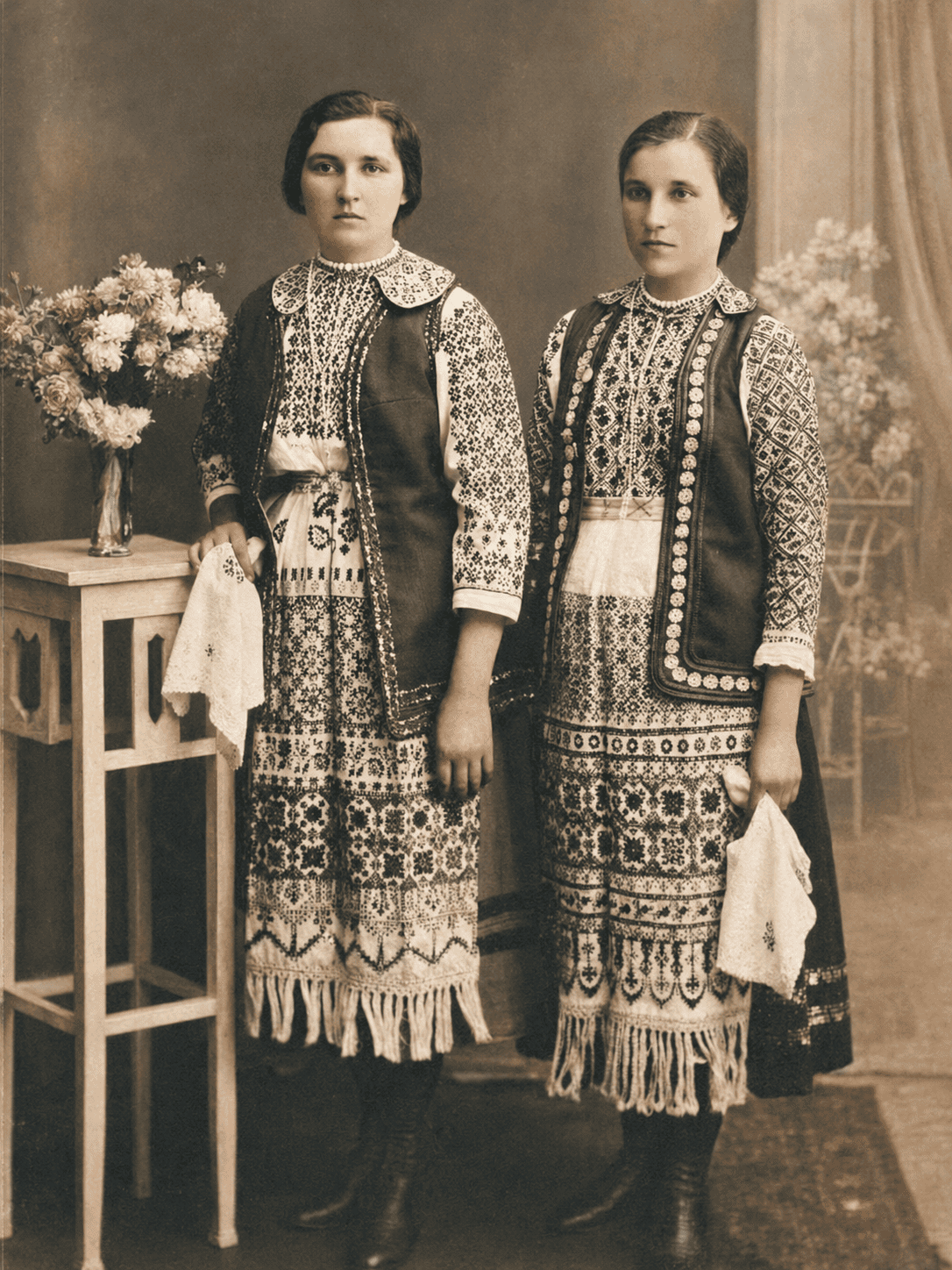
The late 19th century — the dominance of strict geometry. Rhombuses, squares, triangles, eight-pointed stars, meanders. Each element had a sacred meaning: the diagonal cross served as a charm against evil, the rhombus symbolized the fertility of the earth, and the star meant the unity of heaven and earth. Embroidery was mainly done on sleeves, cuffs, and collars — the parts of the shirt visible from under outerwear.
The early 20th century — the beginning of revolutionary changes. Plant motifs began to enter geometric compositions: roses, tulips, periwinkle. At first these were only small borders on the edges of geometric schemes, but gradually floral elements became dominant. Iryna Hurhula, in her work “Folk Art of the Western Regions of Ukraine” (1966), recorded this transition as a characteristic feature of the Sokal region.
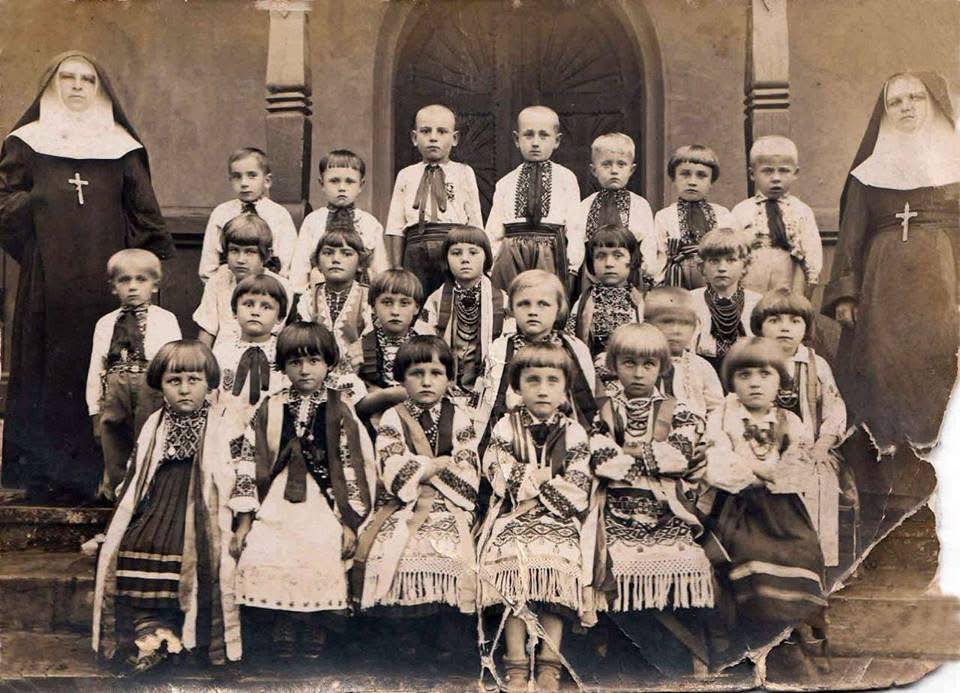
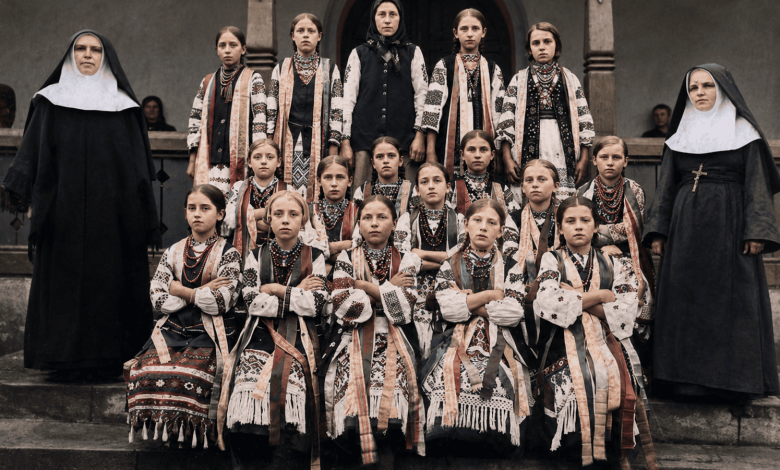
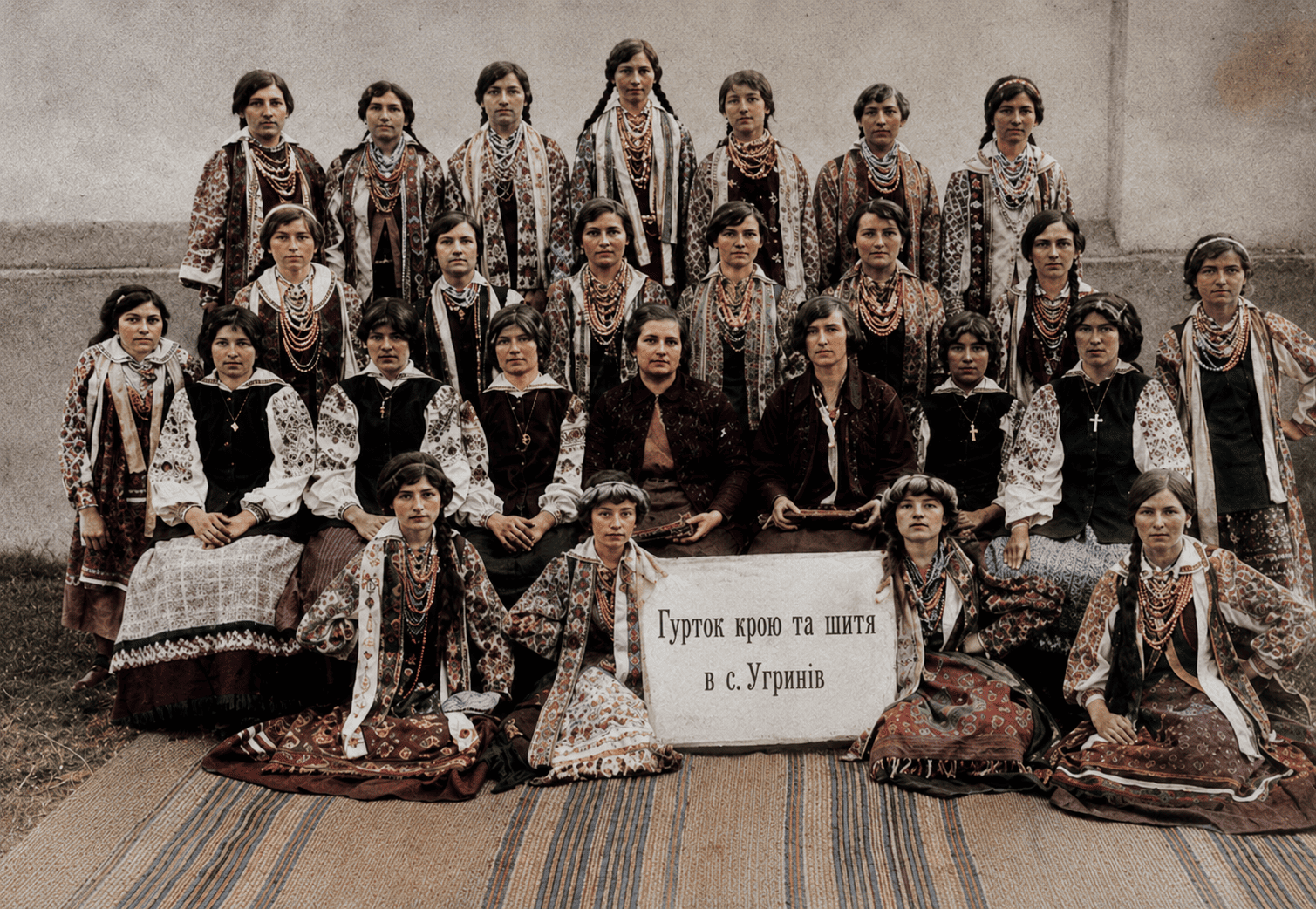
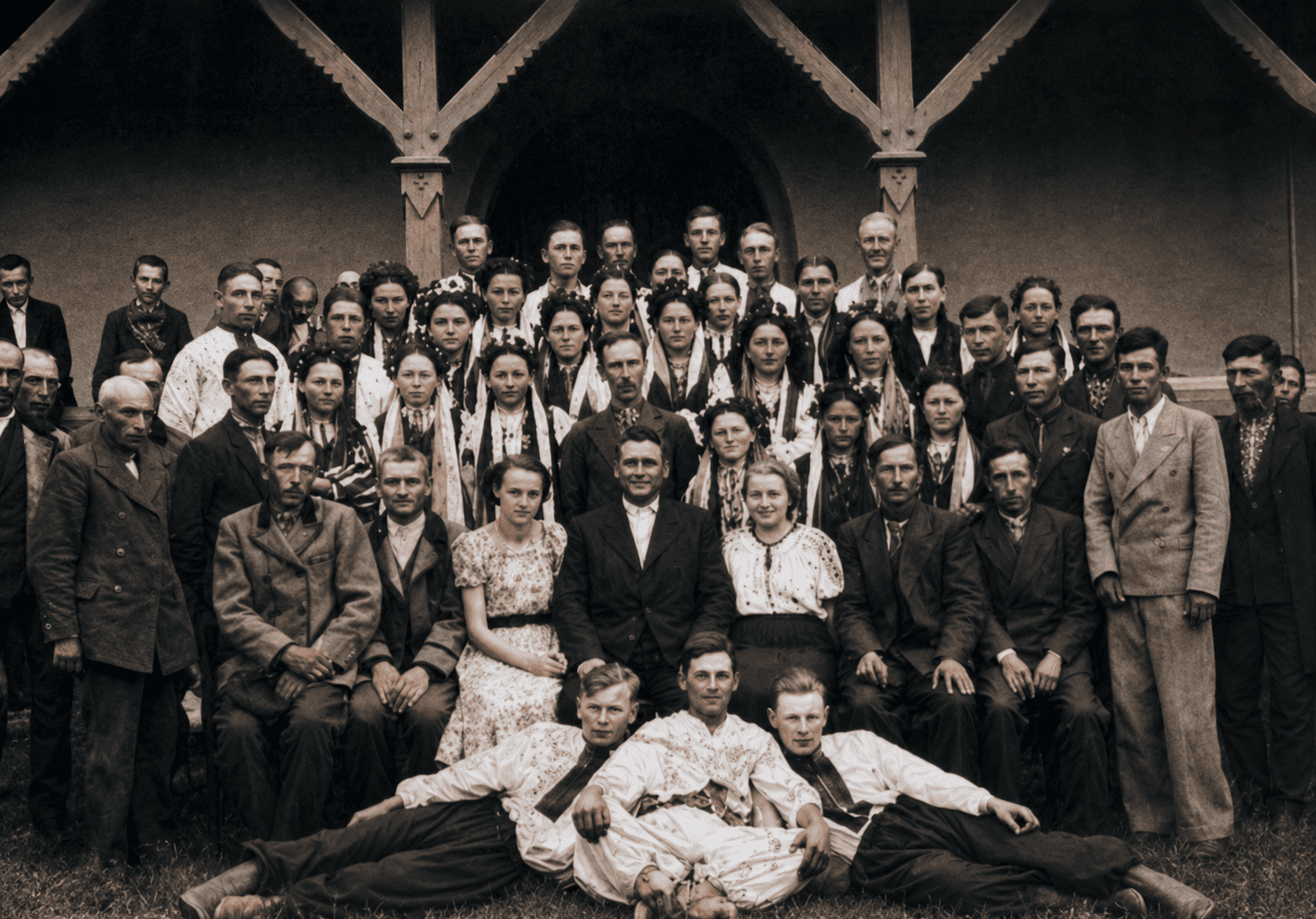
1st row: Shebits Milia, Vorona Nastia, Hnatiuk Hania, Prykhidko Olha, __________, Sereda Milia,
2nd row: Shamborovskyi Volodymyr, (Dziunio), Karpiuk, Levchuk Hanna Vasylivna, Kolida Parania, _______***, Sereda Stefa.
3rd row: Bilyk (professor’s son), Mykytiuk Olia (Kovaleva), Huliavska***, Makhibroda _________, ___________.
4th row: ____________, Hura Stepan Hryhorovych, Smikhura Oles, Senchyna Bohdan, Shklianka Petro, ____________, __________.
From the private collection of Yurii Koren.
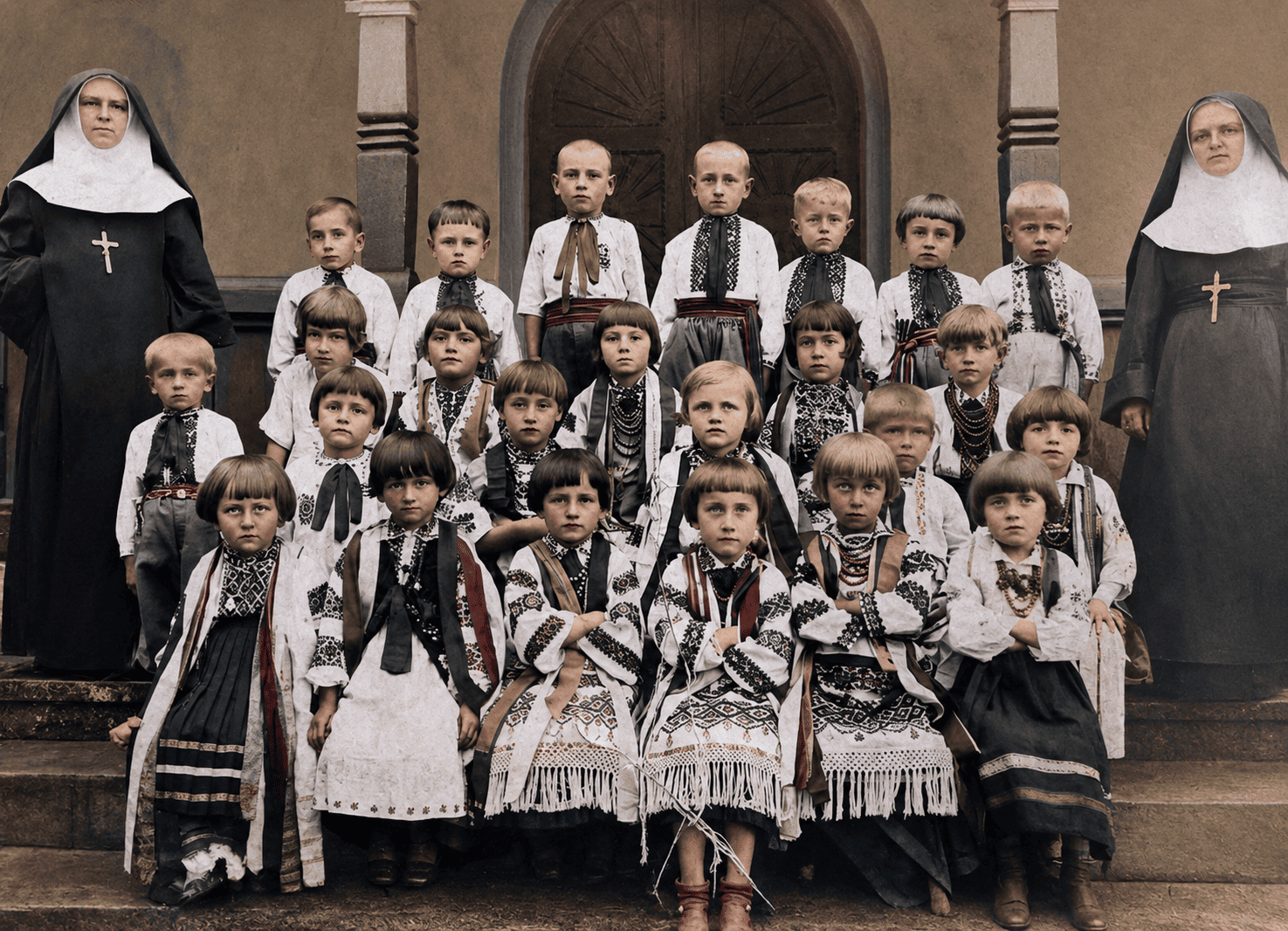
The 1920s–1930s — the period of the greatest flourishing and complexity. Specks of other colors began to be added to black: red, golden, blue-and-yellow. During this period, even patriotic shirts in blue-and-yellow tones appeared — a response to the national movement and the struggle for Ukrainian statehood.
The 1940s and later — the full use of the color spectrum. Sokal embroidery acquired exuberant multicolor richness, although the black classic remained the most revered.
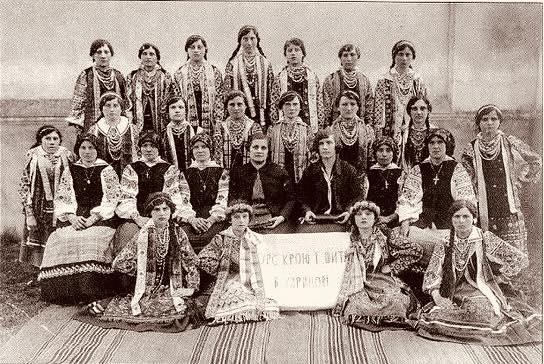
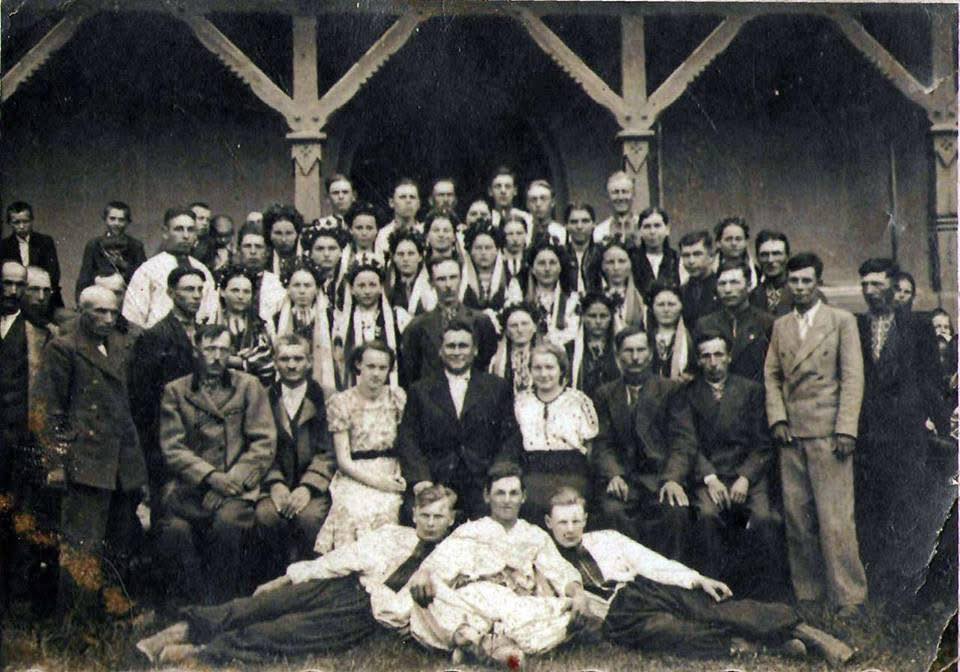
Photograph from the 1930s.
From the collection of Yurii Koren
Photograph from the 1930s.
As Vira Chypurko told the publication “Holos z-nad Buhu”, the oldest printed primary sources of ornaments found on Sokal embroidered shirts are German publications from 1529 by Johann Schönsperger and from 1608 by Sigismund Latomus. These printed samples reached the Sokal region together with threads through merchants. French fashion magazines with patterns for filet embroidery also had a significant influence. In other words, Sokal embroidery is not an isolated phenomenon, but the result of a creative reinterpretation of pan-European influences through the prism of local aesthetic taste.
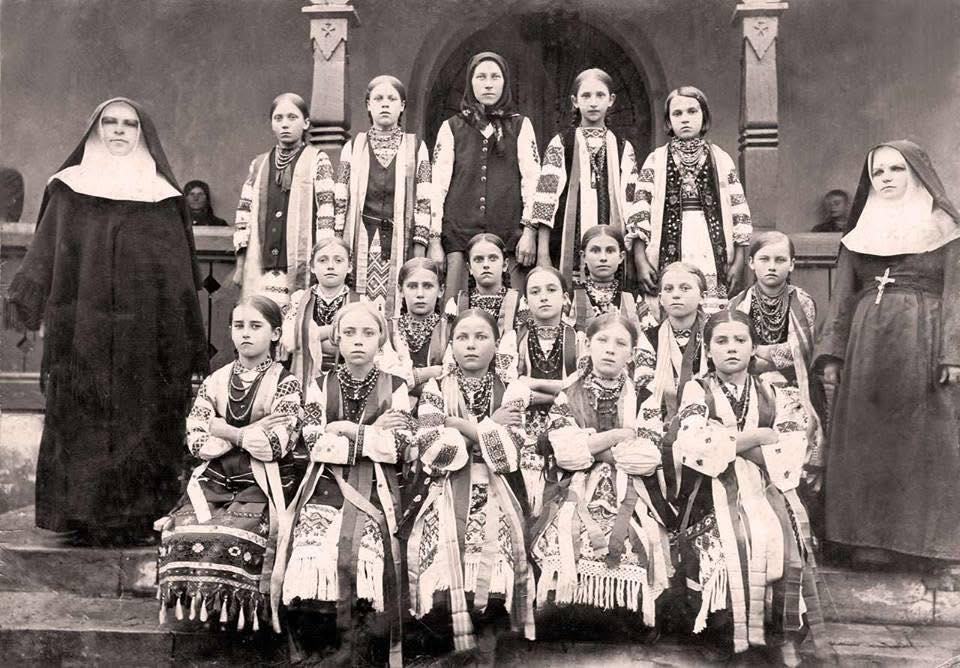
1st row: Malinovska Iryna (Stepasykha), Babska Marysia (Mulchykha), Shtykailo Zosia, Humenchuk Kateryna, Hudym Mariia (Hryneva);
2nd row: Tymoshyk Stefa, Makovska Paraskeviia, Vozniakova Yohyna, Oleksa Hanna, Kozyra Yaryna (Velychkova), Smikhura Yevheniia, Chop Hanna;
3rd row: Dzhura Hanna,____Nastia, Shebits Paraskeviia (Pylypkova) – head of the Union of Ukrainian Women, Prykhidko Hanna (Hrechykha), Kravets Mariika.
According to Kateryna Humenchuk. From the collection of Yurii Koren
Technique and cut: what makes the Sokal shirt unique
The Sokal shirt is not only embroidery, but a complete system of cut, decoration, and construction that distinguishes it from other regional traditions.
Embroidery technique. The main technique is the ordinary cross-stitch, but with local features that make Sokal shirts recognizable. Stem stitch and over-the-needle stitch were also used. As Vira Chypurko noted, at the Ivan Trush Lviv College there was, during training, a qualification scale for the complexity of embroidery from different regions, and the most difficult to embroider are Kosmach and Sokal embroidery. Embroidering plant ornaments with black threads while preserving openwork and lightness is a true test for a craftswoman.
Characteristic cut. The Sokal shirt is distinguished by its large turn-down collar — the so-called “Bogorodychnyi” collar. It is precisely on the collars that absolutely unique ornaments appear, which are not repeated anywhere else and are a characteristic feature of this region. Original cuffs and a specific placement of patterns create a unified composition.
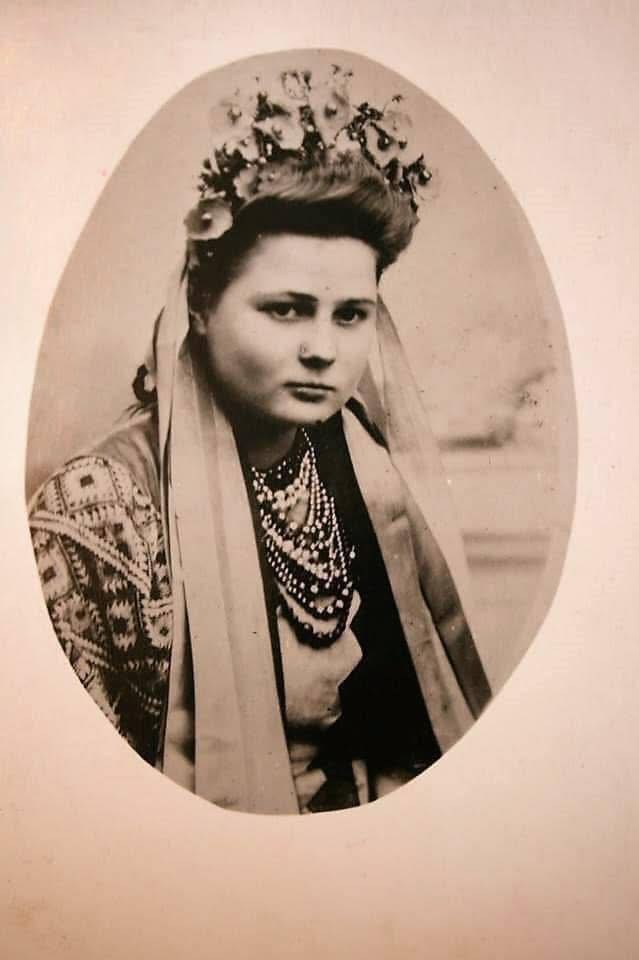
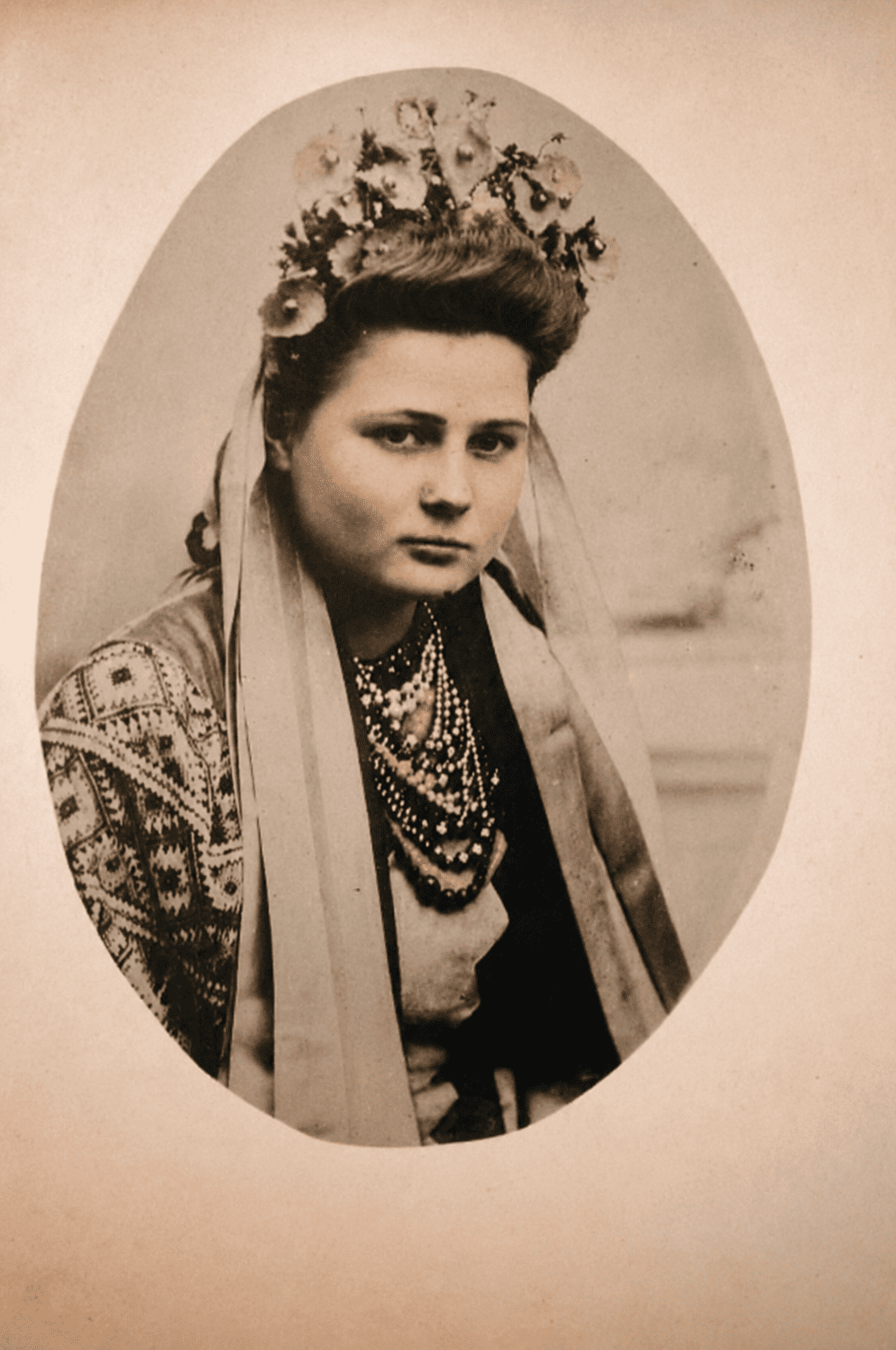
Fabric. For festive shirts, the fabric was necessarily fine linen, while for everyday shirts it was coarse hemp cloth. Both homespun cloth and artel-produced cloth sold at markets were used.
Open space. The Sokal shirt differs from shirts of other regions by its characteristic open white space between the elements of the design. Neat black patterns do not fill the entire surface, but “breathe” against the background of the white fabric, creating the impression of light lace.
Researchers who preserved the heritage
The history of the study of Sokal embroidery spans more than a century, and each generation of researchers has added new facets to the understanding of this art.
Bronisław Sokalski — one of the first to describe the embroidery of the Sokal region at the end of the 19th century in the ethnographic work “Sokal County” (1899, in Polish).
Sofiia Chekhovych — the author of the fundamental work “Folk Art of the Sokal Region” (1957), in which the embroidery traditions of the Bug region were systematically collected and described for the first time.
Iryna Hurhula — a researcher of folk art in Western Ukraine. In the book “Folk Art of the Western Regions of Ukraine” (1966), she recorded the transition from geometric to plant ornament in the Sokal region.
Nataliia Havryliv — the author of the study “Sokal Embroidery” (2015), prepared on the basis of the collections of the Museum of Folk Architecture and Rural Life in Lviv.
Vira Chypurko — a resident of the village of Spasiv in the Sokal community, an expert in artistic and folk embroidery, and a collector of old authentic Ukrainian costumes. Her fundamental art album “Chornotsvit. Sokal. Ornaments. Cut and Ornaments of Nadbuzhanshchyna Shirts” (2023) became an event in Ukrainian ethnography. It brings together samples of shirts from Nadbuzhanshchyna from the late 19th and early 20th centuries, and also includes, for the first time, a translation from Polish of Bronisław Sokalski’s 1899 ethnographic study.
Mariia Dolinovska — a resident of Novovolynsk who has collected a collection of hundreds of authentic Sokal shirts and devoted decades to researching and popularizing this tradition.
From Soviet oblivion to national recognition
During the Soviet period, Sokal embroidery, like many other elements of national culture, underwent contradictory processes. On the one hand, attempts were made to fit the tradition into the framework of Soviet-style “folk creativity”; on the other, true craftswomen continued to preserve authentic patterns, passing them on to descendants despite official unification.
The situation changed fundamentally after Ukraine gained independence, and especially in the 2010s–2020s, when the embroidered shirt became a powerful symbol of national identity. Vyshyvanka Day, which is celebrated on the third Thursday of May, has turned into a real holiday that unites millions of Ukrainians.
The culmination of recognition was the inclusion of the Sokal shirt in the National List of Elements of Ukraine’s Intangible Cultural Heritage by an order of the Ministry of Culture in March 2025. As Maksym Kozytskyi, head of the Lviv Regional Military Administration, noted: “The Sokal shirt is not just clothing. It is memory. It is living history preserved in the hands of our craftswomen”. It became the tenth element from the Lviv region to be included in the national list.
The initiative was led by the Department for Culture, Nationalities and Religions of the Lviv Regional State Administration together with the Chervonohrad District Administration. Local artists played an important role — Vira Chypurko, Iryna Mandryk, Zhanna Zhuravinska, and Nataliia Kutsiaba.
Sokal embroidery today: between the museum and the runway
Today, Sokal embroidery is experiencing a true renaissance. It exists simultaneously in several dimensions.
The museum dimension. Authentic samples are preserved in the Museum of Folk Architecture and Rural Life in Lviv, the Sokal Museum of Local History, and private collections. Exhibitions of Sokal embroidered shirts are regularly held far beyond the Sokal region — for example, in Fastiv.
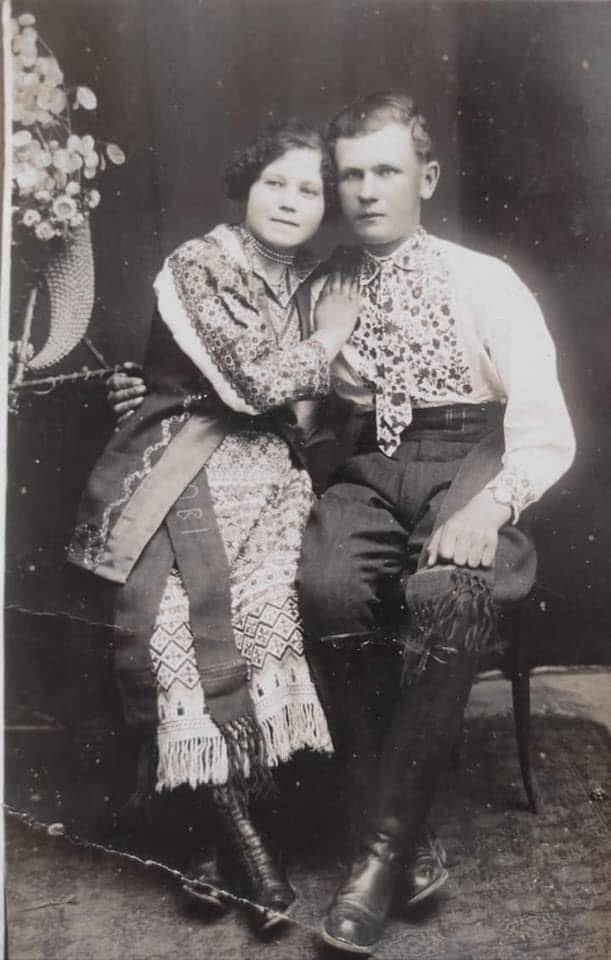
Photograph from the 1920s.
Photo from the family archive of Vita Liushyk.
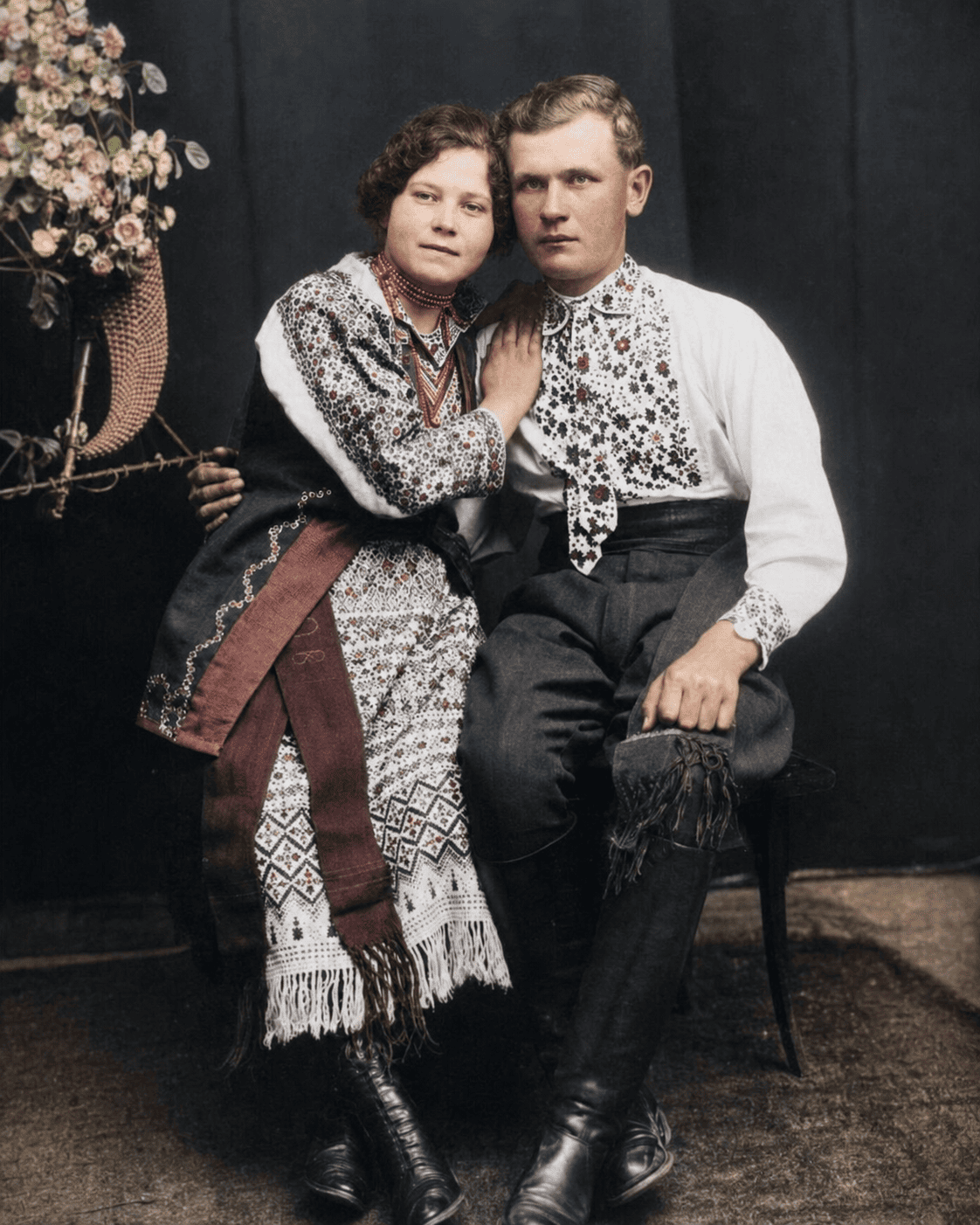
Photograph from the 1920s.
The craft dimension. Craftswomen in the Sokal community continue to work, embroidering authentic shirts according to traditional patterns. Their work is not reconstruction, but a living tradition passed down from mothers and grandmothers. As “Holos Sokalshchyny” notes, Sokal craftswomen preserve not only embroidery, but also the broader cultural context — the traditions of pysanka-making, weaving, and ritual clothing.
The commercial dimension. Sokal ornaments have become among the most popular in contemporary Ukrainian fashion. Numerous manufacturers offer embroidered shirts with Sokal motifs — from handmade work to machine embroidery. But there is also a danger here: mass production often simplifies or distorts authentic patterns, blurring the uniqueness of the tradition.
The educational dimension. Schools and art institutions of the Sokal community hold embroidery workshops. The younger generation learns not only the technique, but also the understanding of the symbolism carried by each element of the ornament.
Why Sokal embroidery matters for all of Ukraine
Sokal embroidery is more than a regional tradition. It is part of the great mosaic of Ukrainian folk embroidery, which, together with Borshchiv black embroidery, Reshetylivka white-on-white embroidery, and the Horodok stitch, forms a unique cultural heritage.
In the context of the full-scale war, the preservation of intangible cultural heritage has acquired existential significance. Every embroidered shirt is an answer to those who are trying to destroy Ukrainian identity. Every preserved ornament is proof of the continuity of a culture that has existed not for years, but for centuries.
As Vira Chypurko aptly said: “Today it can be said with certainty that the embroidered shirt is beyond time and fashion, although cuts and color palettes change. Ukrainians continue to embroider, creating new ornaments and enriching the traditions of Ukrainian embroidery”.
Sokal embroidery lives. It lives in museum showcases and on festive tables, in scholarly albums and Instagram feeds, on grandmother’s shirts taken out of chests for major holidays, and on modern designer dresses. And as long as even one pair of hands takes a needle with black thread and makes the first cross-stitch on white cloth — this tradition will not be broken.
FAQ
Why is Sokal embroidery black? The black color in Sokal embroidery is above all an aesthetic choice of the residents of Nadbuzhanshchyna, not a symbol of mourning, as the popular legend claims. Researcher Vira Chypurko explains that the black-and-white ornament is elegant and classic at the same time. At the same time, red and yellow threads were also used in the 19th century, but it was the black monochrome embroidery that became the region’s hallmark.
How does Sokal embroidery differ from Borshchiv embroidery? Both traditions use black, but they differ in technique, cut, and ornamentation. Sokal embroidery is performed mainly in cross-stitch, with characteristic open white space between the elements, creating a lace effect. Borshchiv embroidery is denser, often uses the “zanyzuvannia” technique, and has a different characteristic shirt cut. The Sokal shirt is also distinguished by its large turn-down “Bogorodychnyi” collar.
Is Sokal embroidery included on the UNESCO list? In March 2025, the Sokal shirt was included in the National List of Elements of Ukraine’s Intangible Cultural Heritage — the first step toward a possible nomination for inclusion on the UNESCO list. The initiative was supported by the Lviv Regional Administration and local artists, including Vira Chypurko, the author of the study “Chornotsvit.”
Where can authentic examples of Sokal embroidery be seen? Authentic Sokal shirts from the 19th–20th centuries are preserved in the Museum of Folk Architecture and Rural Life in Lviv, the Sokal Museum of Local History, and private collections, in particular the collection of Mariia Dolinovska from Novovolynsk, which includes hundreds of examples. Rich illustrative material has also been published in Vira Chypurko’s art album “Chornotsvit” (2023).
How can one learn to embroider a Sokal embroidered shirt? Workshops on authentic embroidery are regularly held in the Sokal community. The main technique is cross-stitch with black threads on white linen. Ornament patterns can be found in the publications of Vira Chypurko and Nataliia Havryliv. It is important to start with geometric motifs — they are the oldest foundation of the Sokal tradition.
The author expresses gratitude to researchers Vira Chypurko, Mariia Dolinovska, and Tetiana Kutsyr, whose many years of work documenting and preserving Sokal embroidery made this publication possible.