

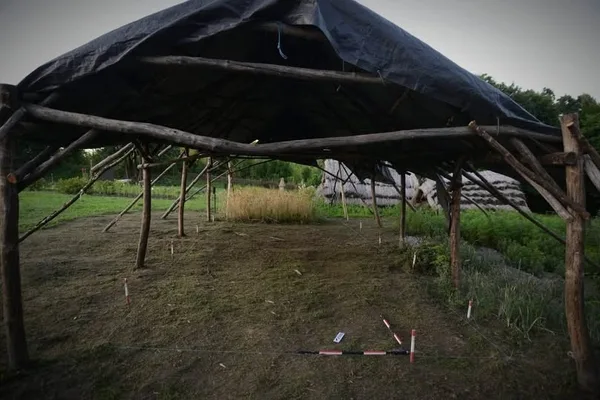
On the territory of the municipal institution of the Lviv Regional Council “Administration of the Historical and Cultural Reserve “Ancient Plisnesk”” archaeologists have completed research on one of the areas of this year’s excavations. Next to the reconstructed ancient dwellings, they have almost fully examined a structure that they are provisionally identifying as a probable workshop dating from the late 9th to the first half of the 10th century.
This structure was discovered in 2023. It stands out among the residential features due to its larger size, irregular shape, shallower depth of foundation and the presence of additional stone paving, which has led researchers to assume it had a production function.
Another structure is located nearby, which had previously been tentatively identified as a pottery workshop. A kiln, a clay pit and a significant quantity of ceramics were found there, so researchers suggest that two production facilities may have operated side by side at the same time.
Among the artefacts discovered in the newly uncovered workshop are ceramics from various periods, as well as iron items: knives, an awl, arrowheads and a whetstone. After being recorded and described, all the finds will be transferred for storage to the reserve’s collections.
This year archaeologists have already investigated two areas of Plisnesk. In one of them they examined an annex to the defensive rampart of the 9th–10th centuries and recorded traces of a probable wooden floor.
Archaeological research at Plisnesk began as early as 1810 and has been ongoing without interruption since 1990. So far only about 1.5% of the site’s territory, which covers approximately 250 hectares, has been studied. Work is scheduled to continue in September.