

The State Inspectorate for Architecture and Urban Planning of Ukraine has introduced an online service that allows developers to appeal refusals to issue urban planning conditions and restrictions. Lviv Deputy Mayor for Urban Planning Liubomyr Zubach believes that such changes in effect turn the inspectorate into a service centre for developers and weaken communities’ ability to control construction.
The official stressed that urban planning conditions and restrictions are a key tool enabling local self-government bodies to regulate what is built on their territory and how. In his view, DIAM’s new approaches demonstrate the state’s retreat from genuine oversight of construction.
“This decision is a perfect illustration of a complete abandonment of construction control in the country. Because the body that is supposed to exercise this control is openly declaring that it is turning into a kind of online service for developers,” emphasised Liubomyr Zubach.
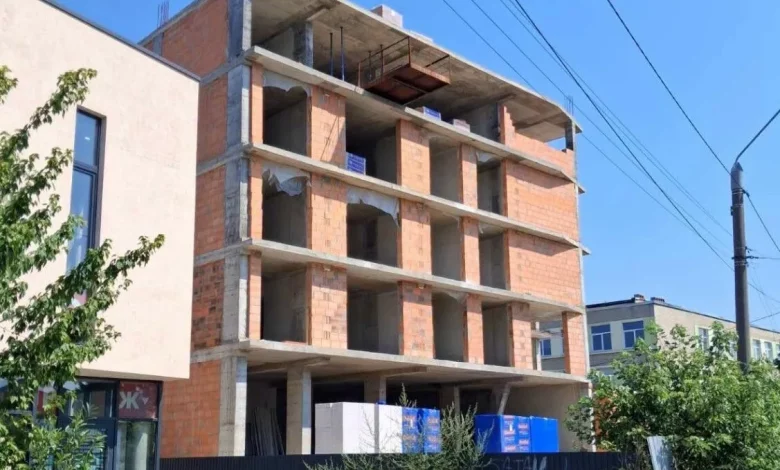
As an example, he cited the construction of a block of flats at 1 Yevhena Olesnytskoho Street in Lviv, in the Levandivka district. A five-storey building with a single entrance has already been erected there: a monolithic frame has been completed and the external brick walls have been partially built, the site is fenced off, and there is existing residential development nearby.
According to Zubach, back in December 2025 the State Architectural and Construction Control Inspectorate in Lviv recognised this site as unauthorised construction, fined the developer and issued an order for demolition. However, roughly six months later DIAM issued a permit for the construction of this very building, citing a “lack of grounds for refusal”.
The official said that in September a citizen, Derkach M. M., applied to Lviv City Council with the intention of building a block of flats on a plot in zone Zh-1, which is designated for detached housing — single-family homes. The city refused to issue urban planning conditions and restrictions. The applicant later withdrew the application and then resubmitted it, this time against the backdrop of court disputes over the city council’s powers to issue such documents.
According to Zubach, the developer took advantage of the “tacit consent” principle: if no refusal is issued within 10 days of the application, the conditions are deemed to have been approved. He noted that in other countries the approval of construction can take much longer, whereas in Ukraine only ten days are allowed for this.
Separately, the deputy mayor drew attention to the fact that on paper the building on Olesnytskoho Street has a CC3 consequence class — the highest level of responsibility for construction projects. In reality, however, it is a five-storey building with a single entrance. In the official’s opinion, the developer deliberately chose this class in order to obtain permitting documents not at local level, but directly through DIAM in Kyiv. Previously, it was only CC3-class projects that could be approved in the capital, whereas now, as Zubach pointed out, DIAM has the right to issue permits for all consequence classes.
He identified engineering networks as another problem. According to him, the building lacks a fully fledged sewerage system: there is only a contract with a neighbouring single-storey house, which is supposedly to provide the new building with water supply and wastewater disposal. A similar situation, the official said, exists with gas supply — the register contains no approvals from the relevant services for the gasification of the site.
In conclusion, Liubomyr Zubach warned that if the current approaches are maintained, the system of construction control may turn into a mere formality, where for a developer to obtain a permit it will be enough simply to upload a covering letter to the online system.
Earlier, Lviv City Council reported that it was preparing a lawsuit to overturn DIAM’s decision granting a permit for the construction of a block of flats at 1 Yevhena Olesnytskoho Street. The municipal SACI inspectorate insists that this is unauthorised construction, in respect of which fines have already been imposed and a demolition order issued.