

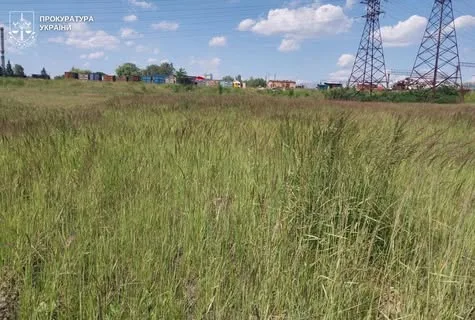
In Lviv, an indictment has been submitted to court against a 33-year-old state registrar, whose actions led to a plot of land worth almost UAH 22 million being removed from the communal ownership of the Lviv territorial community. This was reported by the Frankivsk District Prosecutor’s Office of the city of Lviv.
The case concerns land belonging to the nature reserve fund near the western outskirts of Lviv, with a total area of over 2.7 hectares. According to the investigation, the suspect, being aware that this plot was under seizure in the State Register of Proprietary Rights, imposed by the Zaliznychnyi District Court, unlawfully lifted it.
As the basis for lifting the seizure, she cited a ruling of the Halytskyi District Court, which related to the cancellation of a different seizure in the framework of another criminal proceeding and had not been registered at all in the State Register of Proprietary Rights.
After this, according to the investigation, the woman registered ownership of the land plot in the name of a private company operating in the transport sector. As a result of these actions, the Lviv community lost land with an estimated value of almost UAH 22 million.
The state registrar is charged with unauthorised alteration of information in the State Register of Proprietary Rights to Immovable Property, deliberate failure to comply with a court decision, and abuse of authority for the purpose of obtaining unlawful benefit, which caused grave consequences (Part 3 of Article 362, Part 3 of Article 365-2, Part 3 of Article 382 of the Criminal Code of Ukraine). The pre-trial investigation was conducted by investigators of Police Station No. 1 of Lviv District Police Department No. 2 of the Main Directorate of the National Police in Lviv Region.
Pursuant to Article 62 of the Constitution of Ukraine, a person is presumed innocent of committing a crime and may not be subjected to criminal punishment until their guilt has been proven in the manner prescribed by law and established by a guilty verdict of the court.