

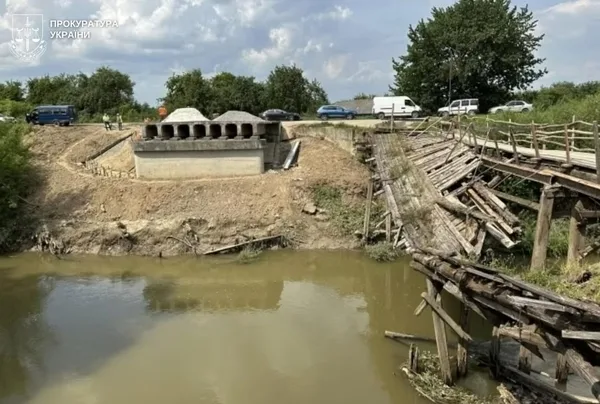
The director of a private enterprise in Lviv region is to stand trial on suspicion of the unlawful misappropriation of local budget funds during the construction of a bridge over the River Dniester. This was reported by the Lviv Regional Prosecutor’s Office.
According to the investigation, in June 2023 a contract was concluded between the city council and the said enterprise for the construction of an engineering structure and the elimination of the consequences of a natural disaster. It concerned the restoration of a bridge over the Dniester, which had been destroyed after heavy thunderstorms and a sharp rise in water levels back in 2008.
Investigators established that the company director entered knowingly false information into certificates of acceptance of completed construction works and statements of their value. The documents, in particular, unjustifiably stated the use of heavy construction equipment and machinery that in fact were not deployed at the site.
On the basis of these documents, the local self-government body settled accounts with the enterprise. As a result, the cost of the works performed was inflated by more than UAH 215,000, which, according to the prosecutor’s office, caused losses to the local budget.
The company director is charged with misappropriation of another’s property through abuse of office, committed under martial law, as well as official forgery (Part 4 of Article 191, Part 1 of Article 366 of the Criminal Code of Ukraine). The indictment has been submitted to the court by prosecutors of the Pustomyty District Prosecutor’s Office, and the pre-trial investigation was conducted by Investigation Unit No. 1 of Lviv District Police Department No. 2 of the Main Directorate of the National Police in Lviv region.
The statement stresses that, in accordance with Article 62 of the Constitution of Ukraine, a person is presumed innocent of committing a crime and may not be subjected to criminal punishment until their guilt has been proven in the manner prescribed by law and established by a guilty verdict of the court.