

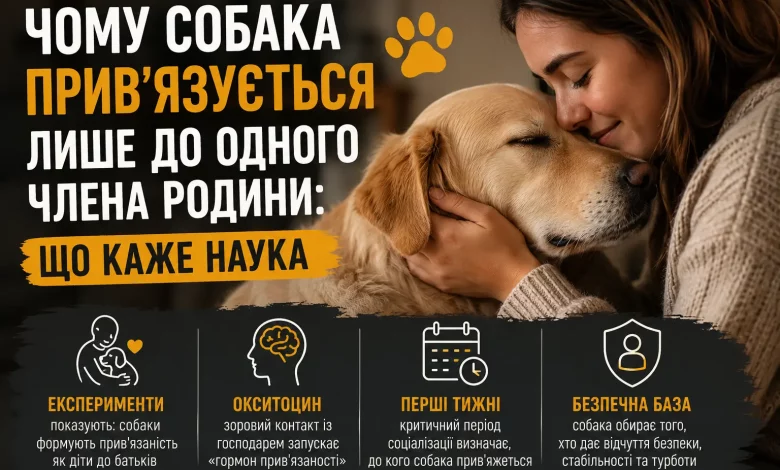
Why Your Dog Bonds With Only One Family Member: What Science Actually Says
You’ve noticed it. Your dog follows you from room to room, ignores the rest of the household, whines the second you grab your keys, and practically levitates with joy when you walk through the door. Meanwhile, your partner — who also feeds the dog and takes him on walks — gets a polite tail wag at best.
This isn’t random. It isn’t ingratitude. And it’s definitely not just about who fills the food bowl. Decades of peer-reviewed research in comparative psychology, neurobiology, and ethology reveal that dogs form targeted attachment bonds with specific individuals through mechanisms remarkably similar to those that bind a human infant to its mother.
The Strange Situation: Dogs Aren’t Just Loyal — They’re Attached
In 1998, a Hungarian research team led by József Topál and Ádám Miklósi did something elegant. They adapted Mary Ainsworth’s classic Strange Situation Test — originally designed to study infant-mother attachment — for domestic dogs. Fifty-one dog-owner pairs went through a structured series of separations, reunions, and encounters with a stranger in an unfamiliar room.
The findings were striking. Adult dogs showed clear attachment patterns directed specifically at their owner: they sought physical contact with that person, showed distress during separation, displayed relief upon reunion, and treated the stranger in a fundamentally different way. The researchers found no significant effect of sex, age, living conditions, or breed on most behavioral variables. In other words, this one-person attachment isn’t a quirk of certain breeds — it’s a species-wide trait.
Source: Topál, J., Miklósi, Á., Csányi, V., & Dóka, A. (1998). Attachment behavior in dogs (Canis familiaris): A new application of Ainsworth’s (1969) Strange Situation Test. Journal of Comparative Psychology, 112(3), 219–229. DOI: 10.1037/0735-7036.112.3.219
Your Dog Uses You as a “Secure Base” — Literally
In developmental psychology, a secure base is the caregiver whose presence allows a child to explore the world with confidence. Palmer and Custance (2008) ran a counterbalanced version of Ainsworth’s test on 38 dog-owner pairs and produced the first clean empirical evidence that dogs use their owner — and specifically their owner, not just any friendly human — as a secure base. Dogs explored an unfamiliar environment more actively when their owner was present than when a stranger was.
In 2013, a team at the University of Vienna (Horn, Huber, and Range) took this further with a manipulative problem-solving task. Dogs were significantly more willing to engage with a challenging puzzle when their owner was in the room than when a stranger was present or when they were alone. One particular person literally gives the dog the emotional security it needs to function normally.
Sources:
- Palmer, R., & Custance, D. (2008). A counterbalanced version of Ainsworth’s Strange Situation Procedure reveals secure-base effects in dog–human relationships. Applied Animal Behaviour Science, 109(2–4), 306–319. DOI: 10.1016/j.applanim.2007.04.002
- Horn, L., Huber, L., & Range, F. (2013). The Importance of the Secure Base Effect for Domestic Dogs – Evidence from a Manipulative Problem-Solving Task. PLoS ONE, 8(5), e65296. DOI: 10.1371/journal.pone.0065296
The Oxytocin Loop: The Chemistry of Eye Contact
In 2015, Miho Nagasawa and colleagues at Azabu University in Japan published a landmark study in Science that changed how we understand the dog-human bond. They found that prolonged mutual gaze between a dog and its owner triggers a self-reinforcing oxytocin feedback loop: oxytocin levels rise in both the dog and the human simultaneously. This is the same neurochemical mechanism that bonds a mother to her infant.
Here’s the critical finding: this loop activated only in dog-owner pairs — not in pairs of hand-raised wolves and their human caregivers. When the researchers administered oxytocin to a separate group of dogs before an interaction, those dogs gazed at their owner even longer (not at a stranger), which in turn raised the owner’s oxytocin levels. A unique biochemical circuit forms between one specific dog and one specific person, and it feeds on itself.
Evan MacLean and Brian Hare of Duke University, writing a companion piece in the same issue of Science, called this finding the strongest evidence yet that humans and dogs are “locked in an oxytocin feedback loop mediated in part through mutual gaze.”
Source: Nagasawa, M., Mitsui, S., En, S., Ohtani, N., Ohta, M., Sakuma, Y., Onaka, T., Mogi, K., & Kikusui, T. (2015). Oxytocin-gaze positive loop and the coevolution of human-dog bonds. Science, 348(6232), 333–336. DOI: 10.1126/science.1261022
The Critical Window: Why the First Weeks Matter So Much
The concept of a critical socialization period in dogs goes back to John Paul Scott and John L. Fuller’s foundational 1965 monograph, Genetics and the Social Behavior of the Dog. They established that puppies are maximally receptive to forming social bonds between roughly 3 and 12–14 weeks of age. During this window, the puppy’s brain is wired for rapid social learning; after it closes, forming primary attachments becomes slower and harder (though not impossible).
Modern research confirms the stakes. Puppies adopted before two months or after four months of age show higher rates of fear, anxiety, and excessive attachment behaviors compared to those placed with new families during the optimal 8- to 12-week window. The person who happens to be the puppy’s consistent, responsive caregiver during this critical period — the one who feeds, soothes, plays, and provides new experiences — has a strong neurobiological head start in becoming “the chosen one.”
Sources:
- Scott, J. P., & Fuller, J. L. (1965). Genetics and the Social Behavior of the Dog. University of Chicago Press.
- Freedman, D. G., King, J. A., & Elliot, O. (1961). Critical period in the social development of dogs. Science, 133(3457), 1016–1017. DOI: 10.1126/science.133.3457.1016
- Pakkala, T., et al. (2025). The Puppies’ Age at Adoption Time Influences the Behavioral Responses of Adult Dog. Animals, 15(3), 447. PMC: PMC11860672
Separation Stress: The Physiological Proof
The attachment isn’t just behavioral — it’s measurable in hormones. Riggio and colleagues studied dog-owner pairs during a Strange Situation Test while collecting saliva samples for cortisol and chromogranin A analysis. During separation from their owner, dogs spent more time near the door (waiting for the owner to return) than during separation from a stranger. At reunion, dogs that initiated more physical contact with their owner had lower chromogranin A levels — they were literally calming down through proximity to that one person.
Source: Riggio, G., et al. (2019). Physiological Indicators of Attachment in Domestic Dogs (Canis familiaris) and Their Owners in the Strange Situation Test. Frontiers in Psychology. PMC: PMC6664005
Breed Matters Less Than You Think
A 2021 study from Linköping University in Sweden (Roth et al.) compared long-term cortisol synchronization across breed groups. Herding breeds — dogs selectively bred for human cooperation over centuries — synchronized their hair cortisol levels with their owners, reflecting shared stress patterns. Ancient breeds and solitary hunting dogs did not.
But here’s the nuance: in those non-synchronizing breeds, long-term stress was more strongly predicted by the owner’s personality traits and the quality of the relationship (measured via the Monash Dog Owner Relationship Scale) than by breed genetics. Breed creates a predisposition toward certain interaction styles, but it’s daily experience — who feeds, walks, trains, and emotionally anchors the dog — that determines who gets chosen.
Source: Roth, L. S. V., et al. (2021). Long-term stress in dogs is related to the human–dog relationship and personality traits. Scientific Reports, 11, 8612. DOI: 10.1038/s41598-021-88087-4
What to Do If Your Dog Didn’t Pick You
If your dog gravitates toward one family member and treats the rest of you like furniture, science offers concrete strategies. Distribute care duties: feeding, walking, and training shouldn’t be monopolized by one person. Use eye contact intentionally — calm, positive mutual gazing triggers the oxytocin loop that builds attachment. Be a consistent source of positive experiences, because the person who reliably provides safety and satisfaction becomes the secure base. And be patient: even adult dogs can form new attachment bonds. A 2025 study on detection dogs found that 16 out of 18 dogs formed secure attachments to a previously unfamiliar human partner after just four weeks of regular bonding sessions.
Source: ScienceDirect (2025). Attachment theory applied to the human-dog relationship. (Secure Base Test and Paired Attachment Test study on detection dogs.)
Peer-Reviewed Sources
- Topál, J., Miklósi, Á., Csányi, V., & Dóka, A. (1998). Attachment behavior in dogs (Canis familiaris): A new application of Ainsworth’s (1969) Strange Situation Test. Journal of Comparative Psychology, 112(3), 219–229. https://pubmed.ncbi.nlm.nih.gov/9770312/
- Palmer, R., & Custance, D. (2008). A counterbalanced version of Ainsworth’s Strange Situation Procedure reveals secure-base effects in dog–human relationships. Applied Animal Behaviour Science, 109(2–4), 306–319. https://doi.org/10.1016/j.applanim.2007.04.002
- Horn, L., Huber, L., & Range, F. (2013). The Importance of the Secure Base Effect for Domestic Dogs – Evidence from a Manipulative Problem-Solving Task. PLoS ONE, 8(5), e65296. https://doi.org/10.1371/journal.pone.0065296
- Nagasawa, M., Mitsui, S., En, S., et al. (2015). Oxytocin-gaze positive loop and the coevolution of human-dog bonds. Science, 348(6232), 333–336. https://doi.org/10.1126/science.1261022
- Scott, J. P., & Fuller, J. L. (1965). Genetics and the Social Behavior of the Dog. University of Chicago Press.
- Freedman, D. G., King, J. A., & Elliot, O. (1961). Critical period in the social development of dogs. Science, 133(3457), 1016–1017. https://doi.org/10.1126/science.133.3457.1016
- Roth, L. S. V., et al. (2021). Long-term stress in dogs is related to the human–dog relationship and personality traits. Scientific Reports, 11, 8612. https://doi.org/10.1038/s41598-021-88087-4
- Riggio, G., et al. (2019). Physiological Indicators of Attachment in Domestic Dogs and Their Owners in the Strange Situation Test. Frontiers in Psychology. https://pmc.ncbi.nlm.nih.gov/articles/PMC6664005/
- Konok, V., et al. (2021). Quantitative Behavioral Analysis and Qualitative Classification of Attachment Styles in Domestic Dogs. Animals, 11(1), 79. https://pmc.ncbi.nlm.nih.gov/articles/PMC7823664/
- Gábor, A., et al. (2024). Domestication and exposure to human social stimuli are not sufficient to trigger attachment to humans: a companion pig-dog comparative study. Scientific Reports, 14, 15673. https://doi.org/10.1038/s41598-024-63529-3