

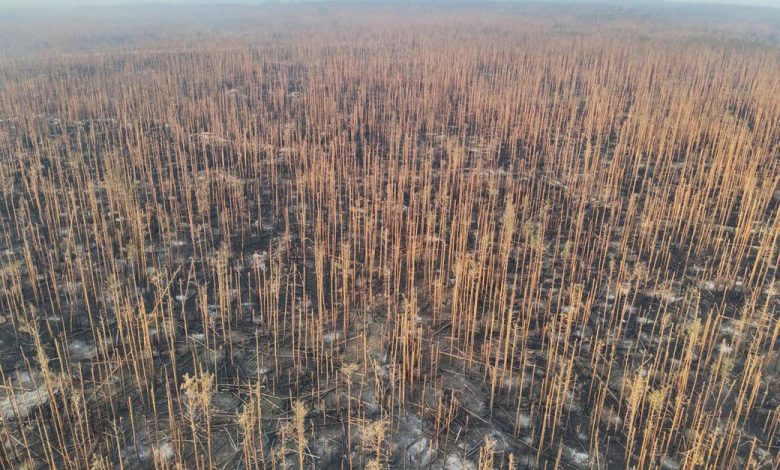
Russia’s invasion has led to the destruction of the only national park in Luhansk region — Kreminski Forests. More than 7,000 hectares of protected land, including the Serebryansky Forest, have burned down. Along with the fires, severe ecological damage has been inflicted: soil has been destroyed, wetlands and floodplains are mined, and critical habitats for rare species have been obliterated.
This area was the largest forested massif in Eastern Ukraine, and exceptional for the steppe zone due to its location between the Siverskyi Donets, Zherebets, and Krasna rivers. It was part of the European Emerald Network and played a vital role in preserving biodiversity in the region. Numerous endangered species and rare flora lived here — many of which are now likely wiped out.
Key consequences of the ecocide:
- 🔥 Over 7,000 hectares of protected forest destroyed by fire
- 🌱 Soil systems severely damaged, hindering natural regeneration
- 💥 Swamps and floodplains heavily mined — demining could take decades
- 🪵 Ongoing illegal logging — trees are being cut for military fortifications and commercial use
- 🐾 Habitats of rare and endangered species have been eradicated
Environmental experts say that even if the fighting ends, full restoration of the ecosystem could take generations, and some areas may never fully recover.
This environmental crime must be thoroughly documented, and all evidence should be submitted to international environmental and legal bodies. The Russian Federation must be held accountable with compensation for losses and obligatory funding for restoration efforts in Ukraine.
“I hope that one day the Kreminski Forests can be revived. But now, we must record every environmental crime to ensure justice is served,” environmental activists state.