

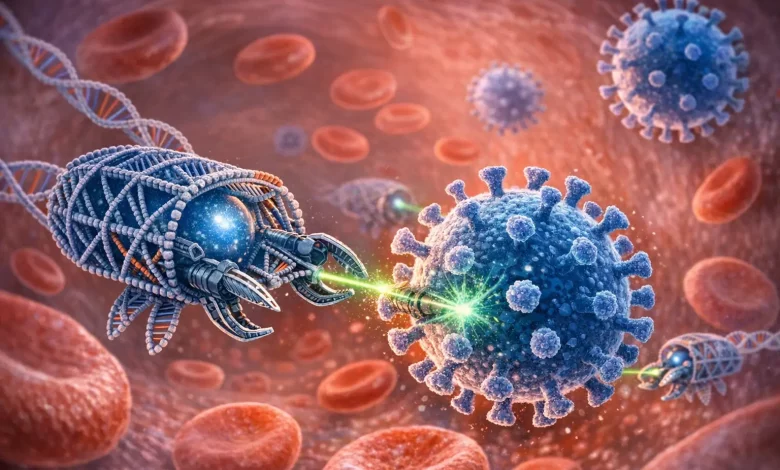
Imagine tiny robots, smaller than a virus, floating in your blood and independently finding cancer cells. This is no longer science fiction — these are exactly the kinds of machines scientists are constructing from DNA molecules. In a new review, as reported in the study, researchers from the Harbin Institute of Technology systematized achievements in the field of DNA robotics and outlined the path from laboratory experiments to real medicine.
The scientific work shows that humanity has, for the first time, come this close to programming the very molecule of heredity as a therapeutic tool. This redefines not only medicine, but also our understanding of what can be considered a “robot” at all.
What is known in brief
- DNA robots are microscopic machines assembled from DNA molecules using DNA origami methods, capable of moving, capturing targets, and executing commands.
- They can deliver drugs precisely to cancer cells, destroy viruses, including SARS-CoV-2, and also assemble nanostructures with atomic precision.
- The movement of such robots is controlled by chemical reactions as well as external signals — light, a magnetic field, or electric current.
- Most DNA robots are still at the “proof of concept” stage: they operate in an isolated environment rather than in a real organism.
- To scale up the technology, scientists plan to involve artificial intelligence and create standardized “libraries” of DNA parts.
What this phenomenon is
DNA is not only a storage medium for genetic information. At its core, it is a molecule with a clear geometry that can “stick” to certain partners according to the laws of chemistry. It is this property that allows scientists to construct complex three-dimensional structures from DNA — much like origami transforms a sheet of paper into a crane.
If a DNA strand is given the required sequence, it will fold itself into the desired shape: a tube, a capsule, or a hinge. Such structures can be “programmed” to open in response to a chemical signal, or equipped with “fuel” — additional DNA strands that make the structure move. This is how molecular-level nanorobotics is born.
Details of the discovery
A team led by scientists from the Harbin Institute of Technology conducted a large-scale review of all known approaches to building DNA machines. The researchers classified them by analogy with conventional robotics: rigid structures, flexible mechanisms, and origami-inspired structures.
The scientists also described control systems separately. The first approach is chemical: a DNA robot receives “fuel” in the form of new molecules that displace the old strand and force the structure to change shape — this is called DNA strand displacement. The second approach is physical: external signals such as a magnetic field or a laser flash can remotely “switch on” and “switch off” the movement of a molecular machine. Both methods allow researchers to achieve subnanometer positioning accuracy — hundreds of times more precise than the most advanced industrial printer.
The size of such robots is several dozen nanometers, which is smaller than most viruses. For comparison, if a nanobot were the size of a human, an ordinary blood cell would appear to it as a building the height of a five-story house.
What the new observations showed
The researchers confirmed that DNA robots have already demonstrated the ability to capture SARS-CoV-2 virus particles under laboratory conditions. Some structures successfully delivered drug molecules directly to target cells without affecting healthy tissues. Others served as programmable templates for assembling nanomaterials with precision at the level of individual atoms — this is critically important for molecular computing devices.
Despite these successes, the scientists candidly identify limitations. Brownian motion — the chaotic vibration of molecules in a liquid — significantly complicates precise control of nanorobots in a living organism. Most machines are still too simple and cannot operate in the complex environment of the bloodstream. There is also a lack of detailed databases on the mechanical properties of DNA structures and reliable computer tools for modeling them.
“The robots of the future will be made not only of metal and plastic,” the research team states. “They will be biological, programmable, and intelligent — tools that will finally allow us to master the molecular world.”
Why this matters for science
This work is important not only as a technical review, but as a signal of the maturity of an entire field. What seemed like science fiction just 20 years ago now has a clear development roadmap. Scientists propose concrete steps: creating standardized “libraries” of DNA components, using artificial intelligence to design new machines, and advancing biomanufacturing.
If the scaling problems can be overcome, the consequences for medicine will be revolutionary. The need for chemotherapy with its devastating side effects will disappear — instead, DNA nanosurgeons will independently find and destroy tumors. New targeted drug delivery could make it possible to treat brain diseases previously considered incurable — barriers between the brain and blood will no longer stand in the way. Even now, researchers studying the rise in cancer incidence place great hopes on molecular medicine.
Beyond healthcare, DNA robots open up new possibilities for molecular computing and the creation of optical devices that will surpass everything currently in existence. This means that the molecule that stores information about life will become the foundation for a new generation of computers.
Interesting facts
- DNA origami — the technique of folding DNA molecules into arbitrary shapes — was first described in the journal Nature in 2006 by Paul Rothemund and gave rise to modern DNA nanorobotics.
- Researchers at Harvard University demonstrated as early as 2012 a DNA capsule that delivered drug molecules to cancer cells and opened only upon contact with them.
- One gram of DNA can theoretically store up to 215 petabytes of information — millions of times more than modern hard drives of the same mass.
- The scale at which DNA robots operate is so small that Brownian motion — the random thermal trembling of molecules — is the equivalent of a constant hurricane for them, fundamentally distinguishing nanorobotics from traditional mechanical engineering.
FAQ
Are DNA robots dangerous for the human body? At present, most DNA robots are being tested only under laboratory conditions. Since they consist of natural biological molecules, the risk of an immune reaction is expected to be significantly lower than from synthetic materials. However, clinical studies in humans have not yet been conducted.
When will DNA robots appear in medicine? According to scientists’ estimates, practical application in medicine is still 10 to 20 years of active research away. The first clinical trials may begin earlier — for the treatment of cancer or viral infections under controlled conditions.
How is a DNA robot different from a conventional drug? Traditional drugs spread throughout the body and affect both diseased and healthy cells. A DNA robot can be programmed to activate only upon contact with a specific disease marker, delivering medication precisely and without affecting healthy tissues.
WOW fact: A DNA nanobot described in Harvard research recognized a cancer cell among millions of healthy ones and opened its cargo capsule at exactly the right location — this entire operation took place autonomously, without any external signal, in a test tube with living cells. This is the first example in science of a programmed molecule independently “making a decision” about treatment.