

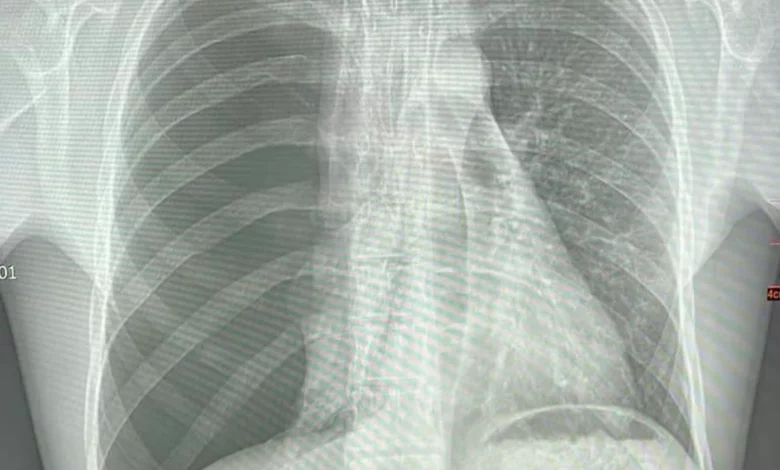
One of the most influential healthcare executives in the United States has publicly declared readiness to do what until recently sounded like science fiction — hand over the initial reading of medical images to artificial intelligence, removing radiologists from the front line of diagnosis. As Radiology Business reports, Mitchell Katz, president and CEO of NYC Health + Hospitals — America’s largest public hospital network — says the technology is already ready, and the main obstacle is not medical but regulatory. The top executive’s remarks stirred the medical community and ignited a debate that reaches far beyond New York.
What is known in brief
- Mitchell Katz leads a network of 11 hospitals that serves more than a million New Yorkers annually and has invested $224 million in upgrading GE imaging equipment.
- At a Crain’s New York Business panel discussion on March 25, 2026, he said: “We could already replace a significant number of radiologists with AI if we were ready for the regulatory challenge.”
- Fellow panelist David Lubarsky of Westchester Medical Center reported that their AI makes errors in breast cancer diagnosis only 3 times out of 10,000 images for low-risk patients — and that this is “better than a human.”
- Radiologists sharply reject this position, calling it “naive” and dangerous for patients.
- Current New York State law requires mandatory radiologist oversight of any reading of medical images; Katz wants to change that.
What radiology is and why it is a target for AI
Radiology is a medical specialty focused on interpreting medical images: X-rays, CT scans, MRIs, mammography, and ultrasound. A radiologist analyzes these images and reports to the physician findings that may indicate disease. It is one of the most “digital” specialties in medicine: almost all the work consists of analyzing pixels rather than direct contact with the patient.
That is why radiology has long been the primary target for medical AI developers. Computer vision is trained to recognize pathological patterns in millions of images and compare them with new ones. In routine screenings, where most images are normal, this task is fundamentally similar to pattern recognition — and here algorithms really can be highly accurate. Microsoft research confirms: the more a person trusts AI in routine tasks, the less they engage their own critical thinking — and this principle applies not only to ordinary users, but also to doctors.
Details of the statement and arguments in favor of AI
Katz came to the discussion with statistics and a concrete proposal. His hospital system has already invested $224 million in new imaging equipment. Now he wants AI to serve as the “first reader” of routine screenings — primarily mammograms and X-rays — and only if abnormalities are detected would the image be passed on to a radiologist.
David Lubarsky, president and CEO of Westchester Medical Center Health Network, backed him up with specific data. Their AI has already been deployed in real practice, and for low-risk women with a negative mammogram result, the system makes errors only three times per ten thousand images. “AI is actually better than humans,” he said without reservation. Sandra Scott, director of One Brooklyn Health — a small hospital with severe financial constraints — called such an approach “revolutionary” for institutions serving the city’s poorest neighborhoods.
The logic is simple: fewer radiologist salaries means broader screening coverage for the same money. Katz directly asked his fellow executives whether there were any reasons not to lobby for changes to New York law to allow AI to read images without mandatory radiologist oversight.
What real clinical practice shows
A similar discussion had already taken place in the public sphere: Anthropic CEO Dario Amodei recently said on a podcast that AI had already taken over the main function of radiologists. Radiologists criticized those words as an exaggeration. They reacted similarly to Katz’s remarks.
Mohammed Suhail, a radiologist at North Coast Imaging in San Diego, responded with visible irritation: “Irrefutable proof that arrogantly ignorant hospital administrators are dangerous to patients: they are easily fooled by IT companies that are nowhere close to delivering medical care.” According to him, any attempt to implement AI-only image reading “will immediately lead to patient harm and deaths.”
Critics point to a key problem that is well illustrated by the debate about AI in higher education: when AI says “normal” and no radiologist checks it, false negatives become systematically invisible. No one knows what was missed because there is no error-tracking mechanism. Accuracy of 99.97% on curated datasets from academic centers may differ significantly from real-world conditions: different equipment, atypical patients, rare pathologies that were not present in the training data.
Why this matters for the future of medicine
This controversy is unfolding against the backdrop of a real crisis in radiology: demand for imaging is growing, there are not enough radiologists, and their salaries are rising rapidly. A report by the Neiman Health Policy Institute, published in the journal JACR, states: “these trends most likely indicate that radiology workforce capacity has been exhausted.” One radiologist can physically review only a limited number of images per day.
At the same time, scientists from Stanford and leading European universities insist that a radiologist’s job is not limited to image classification. It includes triaging complex cases, training residents, and interacting with clinicians in nonstandard situations — and none of these aspects can yet be automated. Nvidia CEO Jensen Huang recently acknowledged that alarmist predictions about the disappearance of radiologists due to computer vision “went too far” and negatively affected the influx of young doctors into the specialty.
There is also a fundamental question of fairness: breast cancer among women is becoming an increasingly widespread problem, and if AI-based image reading makes it possible to reach millions of women who currently lack access to screening, the potential benefit could be enormous. But if the percentage of missed cancers rises at the same time, the harm will also be enormous — and invisible.
Interesting facts
- As of 2026, the U.S. FDA has approved more than 950 AI algorithms for medical devices, the overwhelming majority of which relate specifically to radiological diagnostics — X-rays, CT scans, and MRIs.
- The first AI algorithm for mammogram screening received FDA approval back in 1998. For more than a quarter of a century, this technology was used exclusively as an assistive tool rather than a replacement for a radiologist — and only now has the debate reached the question of full autonomy. A detailed chronology is provided by the American College of Radiology (ACR).
- A missed breast cancer on a mammogram is one of the most common causes of medical lawsuits in the United States. According to The New England Journal of Medicine, up to 30% of breast cancer cases are missed on the initial screening read even by experienced radiologists — which is the main argument of AI supporters.
- The model “AI reads first, radiologist checks the abnormal cases” has already been successfully implemented in Sweden: a study published in The Lancet Oncology showed that this approach detects 20% more cancers than standard double reading by two radiologists, while cutting staff workload in half.
FAQ
Can AI really replace a radiologist? For very narrow and standardized tasks — for example, the initial screening of mammograms in low-risk women — the accuracy of modern algorithms is indeed comparable to or exceeds human performance under controlled conditions. But radiology includes hundreds of different types of pathology in complex clinical contexts, where AI still falls far short of an experienced specialist.
What exactly is preventing AI from replacing radiologists right now? The main barrier is regulatory. New York State laws and U.S. federal legislation require medical images to be read by a licensed radiologist. Changing this rule would require either a regulator’s decision or new legislative initiatives, as well as, clearly, overcoming resistance from the medical community.
What might a compromise option look like? Most experts, including critics of full replacement, agree that AI as a “first reader,” followed by radiologist review only of abnormal images, is a promising model. It expands screening coverage, reduces the burden on specialists, and preserves human oversight where it matters most.
WOW fact: If AI reads mammograms with 99.97% accuracy — and NYC Health + Hospitals performs hundreds of thousands of them annually — even those three errors per ten thousand images mean potentially dozens of missed cancer diagnoses every year in just one hospital network. It is this math, rather than the technology itself, that is the real heart of the controversy.